
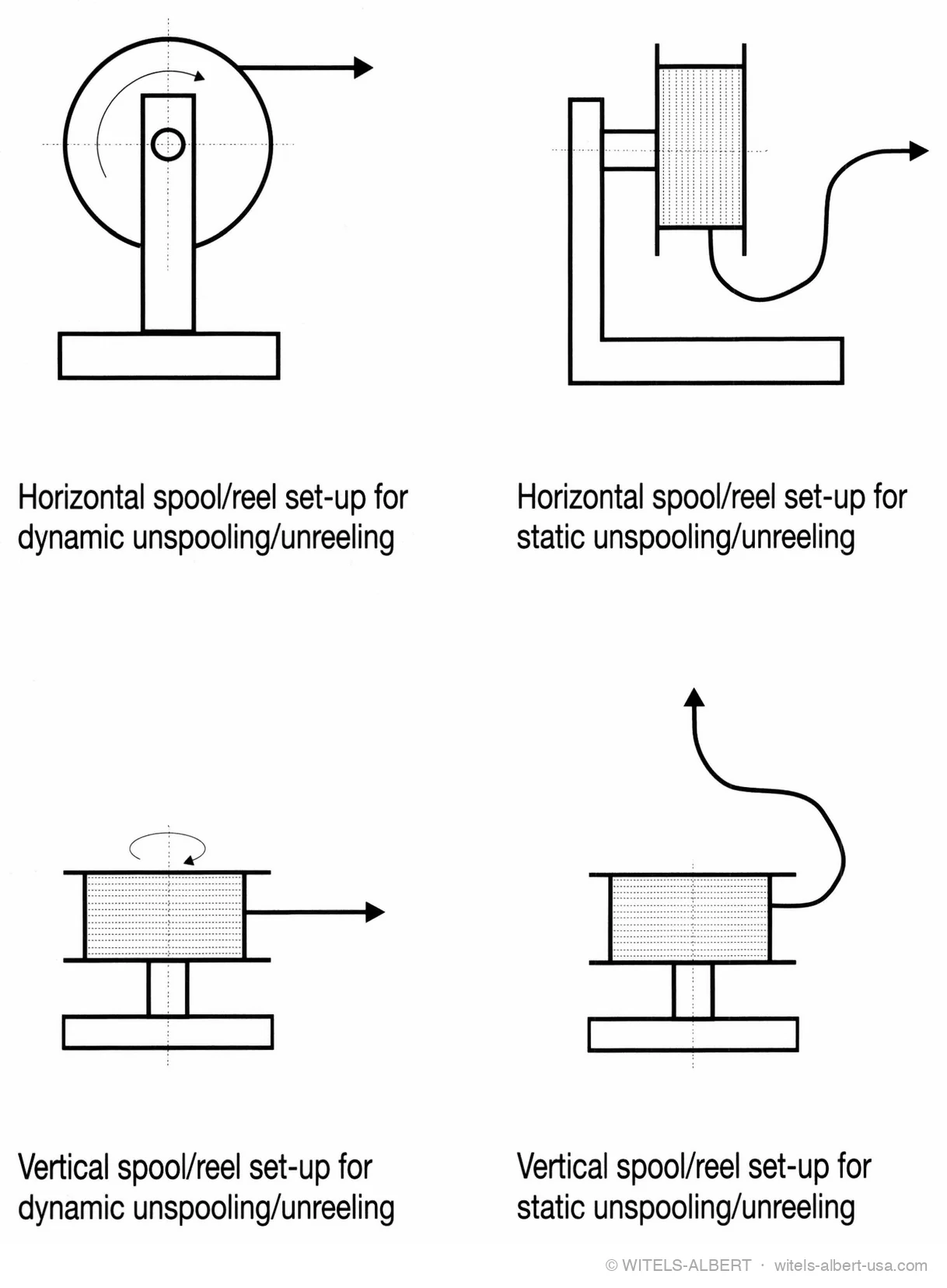
Unspooling (unwinding) is paying off material to be straightened from a spool or reel, either statically or dynamically. In static pay-off the spool stays fixed and material is pulled off axially, which twists each winding; in dynamic pay-off the spool rotates so the material comes off without torsion. Horizontal pay-off is more elaborate technically but is the better solution for follow-up processing.
Basically the methods used to unspool or unwind a material which is to be straightened break down into two categories: static or dynamic.
With the static method the spool or reel is not moved. Material is paid off in axial direction so that a helix or twist is created in each winding as it is removed, with negative consequences for the follow-up process.
With the dynamic method of pay-off the spool or reel is rotated around its axis, which may be arranged vertically or horizontally, enabling the material to be paid off without suffering any torsion.
Windings are at risk of slipping only in vertical unspooling or unreeling set-ups, particularly in intermittent processes. A horizontal pay-off may be more elaborate technically, but it is the better solution with a view to follow-up processing operations.
Frequently asked questions
What is the difference between static and dynamic unspooling?
Static: the spool or reel does not move and material is paid off axially, creating a helix or twist in each winding. Dynamic: the spool or reel rotates around its axis, vertically or horizontally, so material is paid off without torsion.
Is vertical or horizontal pay-off better?
Windings risk slipping only in vertical set-ups, particularly in intermittent processes. A horizontal pay-off may be more elaborate technically, but it is the better solution for follow-up processing.
Why does unspooling matter for straightening?
Twist introduced during static pay-off has negative consequences for the follow-up process, including straightening.
Adapted from "We do it straight" — Wire Straightening, p. 193 (ISBN 3-00-005897-4).
Last reviewed .