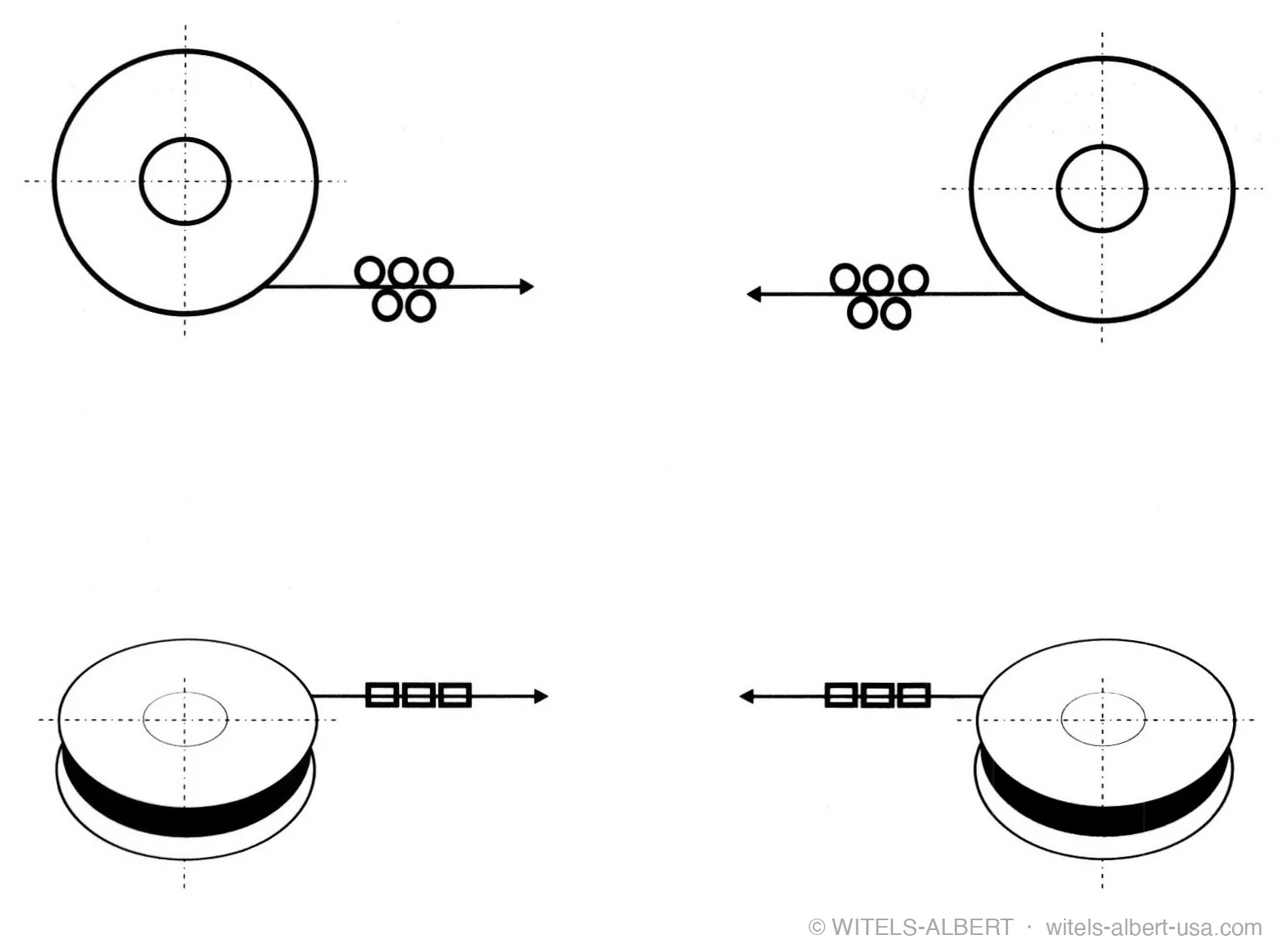
The curvature plane of the initial curvature decides the arrangement of the follow-up straightener. Spools, coilers or deflecting rolls with horizontal axes are followed by straightening rolls arranged on the same plane, those with vertical axes likewise.
The straightening and curvature plane is not altered until in the follow-up process. This applies for several straightening planes as well as for successive changes of direction.
To establish and maintain the correct curvature course during straightening it is necessary to observe the following order: initial curvature, counter-curvature, final curvature.
Two frequently made errors:
- The first straightening device is not arranged with its axis parallel to the unspooling or deflecting roll axis but is turned through 90 degrees. Instead of the first essential counter-curvature being applied to the material to be straightened, the material is made to adopt additional lateral curvatures.
- Although the first straightening device is arranged with its axis parallel to the unspooling or deflecting roll axis, the first and third straightening roll do not touch the material on the spool side but on the opposite side. Hence the second straightening roll does not create the necessary counter-bend but confirms or reinforces the initial curvature. In this case the first two straightening rolls of the straightening device perform no straightening function.
Adapted from "We do it straight" — Wire Straightening, p. 123 (ISBN 3-00-005897-4).