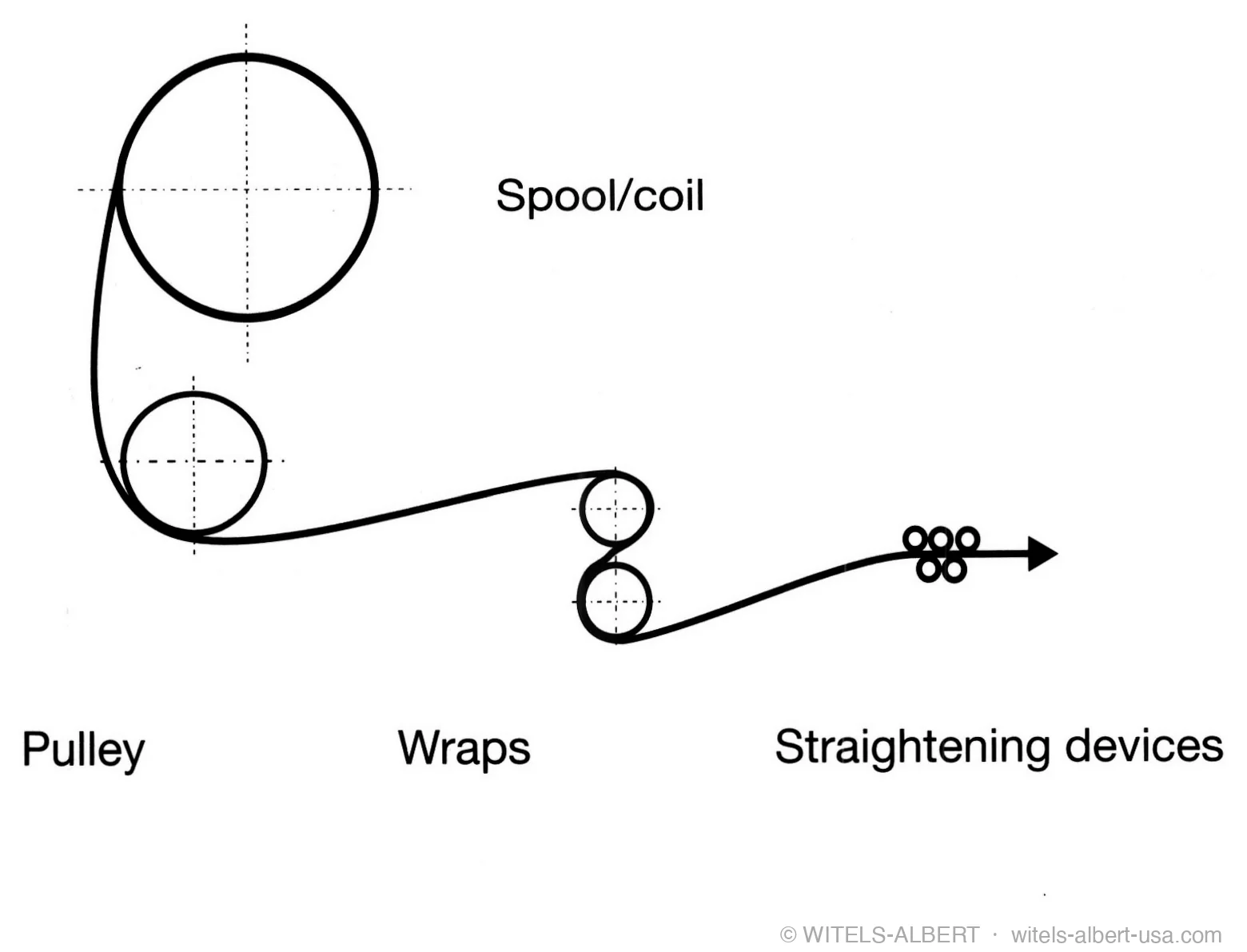
The material straightening process requires the application of forces and moments in order to move the material and to deform it.
Pull-off force is the force needed to pull the material to be straightened through a line, a machine or tooling.
The necessary level of pull-off force depends on the following factors:
- the forces of acceleration for the coil/spool to overcome the moments of inertia,
- the frictional forces needed to overcome the bearing friction of the coil/spool,
- the tensile forces resulting from the bends and the bearing friction of the deflectors,
- the tensile forces resulting from the bends and the bearing friction of the material wraps (particularly on killing-straighteners),
- the tensile forces resulting from the bends (e.g. straightening force) and the bearing friction of the straightening device.
To determine the driving force it is necessary to calculate or estimate the variables affecting the pull-off forces.
Frictional forces in the bearings and between the deflecting, bending and straightening rolls and the material to be straightened depend on the type of bearing and are generally small enough to be neglected. In discontinuous processes and when dealing with large spool and coil masses the pull-off force is largely made up of the force of acceleration. The role played by tensile force from bends increases with the number of straightening rolls (and deflecting rolls) and the size of their adjustment.
For a better and more exact assessment of pull-off forces it is recommended to separate the processes involved. This requires separate drives for the spooling process and the straightening process.
Adapted from "We do it straight" — Wire Straightening, p. 131 (ISBN 3-00-005897-4).