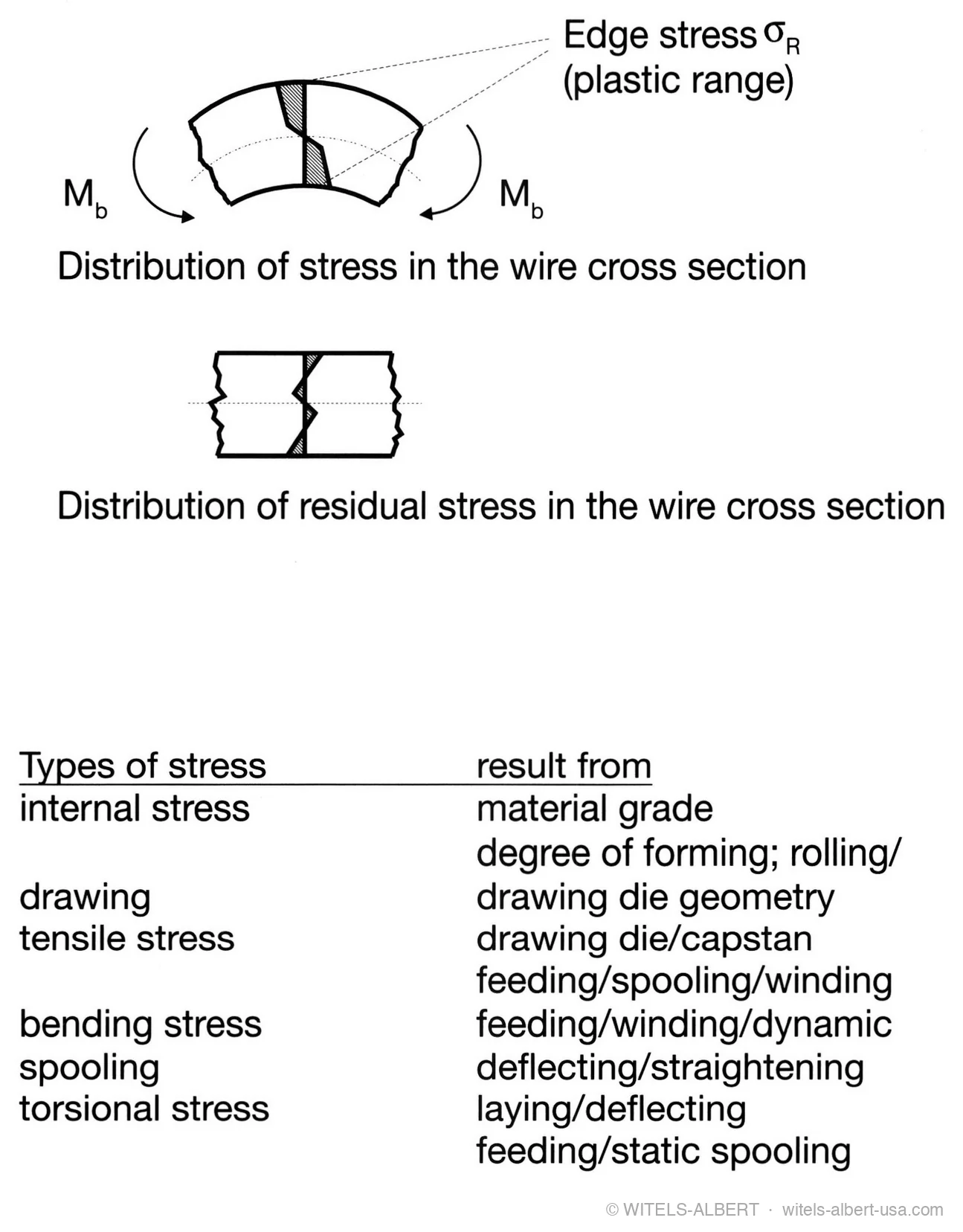
Stress is the reaction of a material/workpiece to an external load. It is defined as an internal force of resistance per unit of area. There is a fundamental correlation between the condition of stress and the condition of deformation of a workpiece. A plastic deformation produces internal stresses in a workpiece which remain after the load is removed. Stresses arising during loading of such a plastically deformed workpiece are superimposed on these internal stresses. The type of stress produced during loading is characterized by the type of load. Tensile forces (drawing, coiling) result in tensile stresses while bending forces (deflecting, straightening) result in bending stresses.
Adapted from "We do it straight" — Wire Straightening, p. 43 (ISBN 3-00-005897-4).