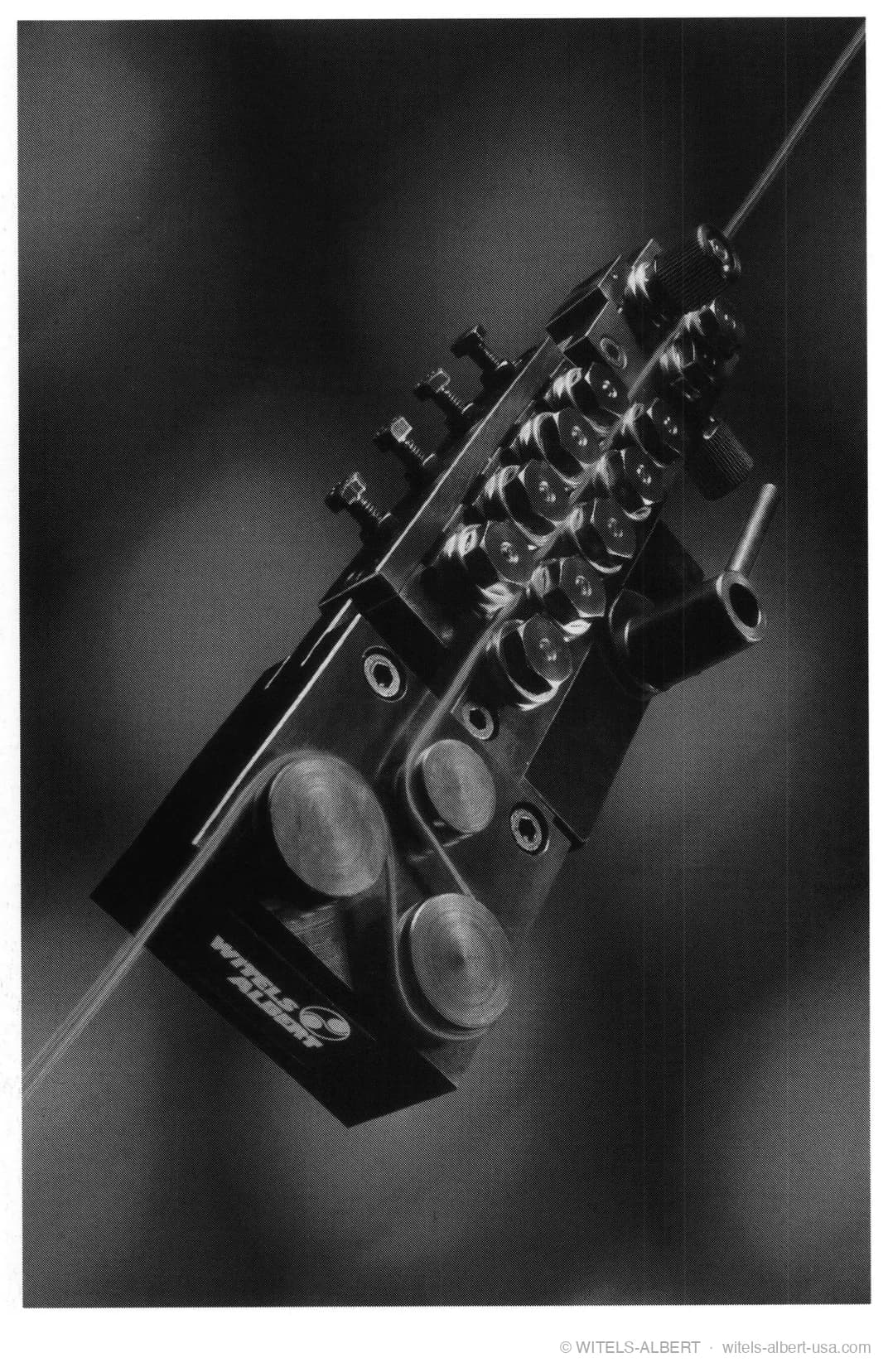
A straightening system is understood to be a combination of straighteners which, duly adapted to the product to be straightened, transform difficult and sometimes alternating initial material parameters into constant values.
The constant process transition thus obtained is essential for designing controlled follow-up processes.
The simplest straightening system generally consists of two individual straighteners arranged in different planes and mounted using a connecting bracket. Acceptable, constant results are achieved in many applications using a simple straightening system of this type.
If the initial parameters of the product to be straightened change during the process and if, for example, curvature fluctuations or helicities arise, then it will be necessary to use problem-related tools and jigs such as helix straighteners, killing-straighteners, etc.
A straightening system set-up consists accordingly of a clearly structured straightening process sequence. Fluctuating initial parameters require greater structuring of the straightening process to achieve a defined and constant final curvature. Simply increasing the number of straightening rolls would have little effect in this case.
The first priority is to transform changing curvatures in different planes into a constant curvature in a single plane. This is the essence of a successful straightening process with constant final curvatures.
Adapted from "We do it straight" — Wire Straightening, p. 177 (ISBN 3-00-005897-4).