Empiricism stands for the gaining of knowledge through experience without the aid of theory.
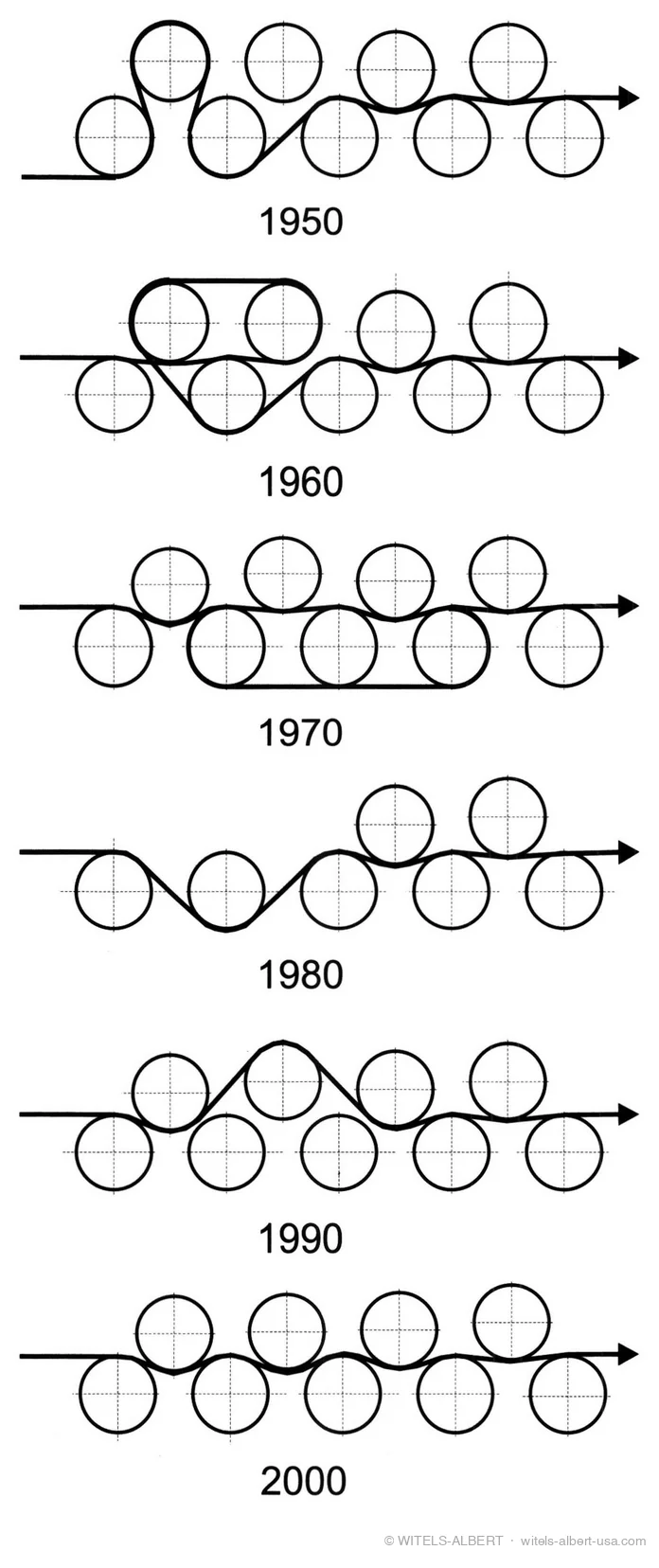
A highly interesting development sequence emerges if we consider the historical development of the straightening process - and particularly the arrangement of a material's curvature course through a straightener - in an empirical light.
In the 1950s, 1960s and 1970s, wire was forced around extreme deflections in a manner that is now almost impossible to comprehend. In the 1980s and 1990s, on the other hand, such extreme curvature courses are visible only in part.
All these set-ups share a common aim - to pre-dress the wire prior to the actual straightening process. By subjecting the material to such extreme bending it adopts a practically constant initial curvature for the straightening process.
The reasons for this empirical development are to be found mainly in developments in the production engineering field. The overhead drawing machines of the 1950s, 1960s and 1970s produced a material with far higher helicity components than a modern-day straight-line drawing machine with practically constant curvature courses.
The lesson to be drawn from this is that developments should follow only one direction: Avoiding the avoidable and creating constant process transitions aimed at constant process results.
The new generation of roll-type straighteners draws increasingly on scientific theory and findings in addition to empirical knowledge.
Adapted from "We do it straight" — Wire Straightening, p. 81 (ISBN 3-00-005897-4).