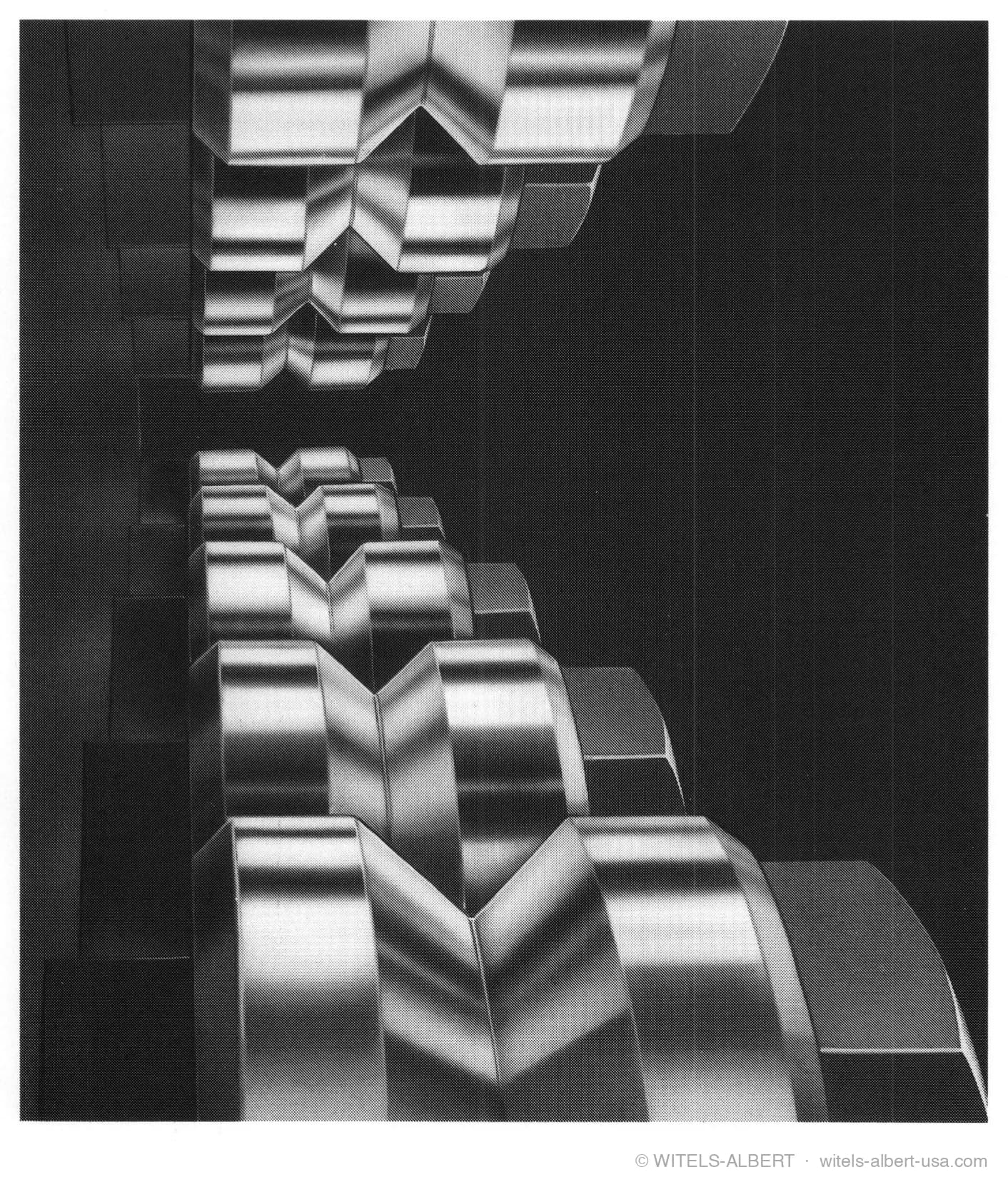
Using a roll-type straightener it is possible to change a process material's unidimensional initial curvatures, i.e. initial curvatures in one plane, so that defined final curvatures remain after the straightening process. The bending tools of such a roll-type straightener are straightening rolls arranged in two parallel, mutually offset rows. When the rolls are accordingly adjusted, the process material is subjected to alternating bends as it passes through the straightener. The number and magnitude of these alternating bends must be such that the initial curves are changed in defined manner over the complete length of the product to be straightened.
To straighten a product over its complete length it has to be transported relative to the straightener. For this purpose, straightening machines are equipped with driven rolls. By contrast, the rolls on a straightener are not driven, i.e. additional devices such as drive units, pull-in units, drivers or the like are required to transport the product to be straightened.
In other words, a straightening machine has technical elements for transporting as well as straightening the product, whereas a straightener has only elements for straightening it. By this definition it is possible to use straighteners in straightening machines.
Straighteners can be classified in terms of their degree of automation. WITELS-ALBERT offers products for conventional straightening, semi-automatic straightening, and straightening with automatic roll positioners. Automatic straightening is currently the subject of intensive research. Each sector should have a matching straightener with specific features that can be adapted to the cross section to be straightened and to the properties of the process material.
Adapted from "We do it straight" — Wire Straightening, p. 137 (ISBN 3-00-005897-4).