
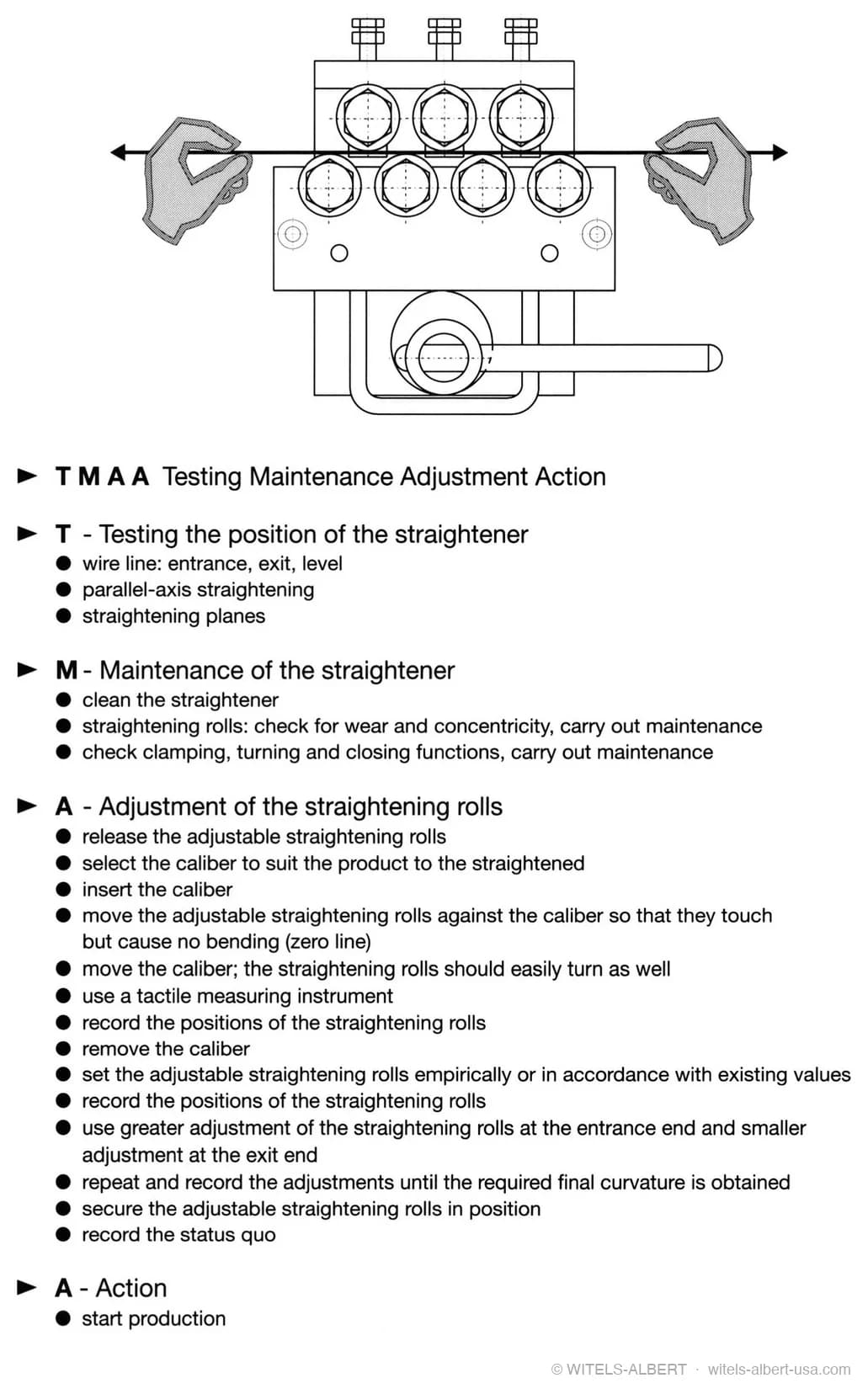
The TMAA checklist is a four-step sequence for setting up a roll straightener so nothing is forgotten: Testing, Maintenance, Adjustment, Action. You test the straightener's position (wire line, parallel axes, straightening planes), maintain it (clean it, check rolls for wear and concentricity), adjust the rolls from a recorded zero line using a calibre, then start production.
The purpose of a checklist is to ensure that nothing is forgotten and that steps are performed in an essential order. It is a blueprint for preventing mistakes.
The facing page shows the TMAA checklist (Testing, Maintenance, Adjustment, Action):
T - Testing the position of the straightener: wire line (entrance, exit, level); parallel-axis straightening; straightening planes.
M - Maintenance of the straightener: clean the straightener; check the straightening rolls for wear and concentricity and carry out maintenance; check clamping, turning and closing functions and carry out maintenance.
A - Adjustment of the straightening rolls: release the adjustable straightening rolls; select the caliber to suit the product to be straightened; insert the caliber; move the adjustable straightening rolls against the caliber so that they touch but cause no bending (zero line); move the caliber - the straightening rolls should easily turn as well; use a tactile measuring instrument; record the positions of the straightening rolls; remove the caliber; set the adjustable straightening rolls empirically or in accordance with existing values; record the positions of the straightening rolls; use greater adjustment of the straightening rolls at the entrance end and smaller adjustment at the exit end; repeat and record the adjustments until the required final curvature is obtained; secure the adjustable straightening rolls in position; record the status quo.
A - Action: start production.
Frequently asked questions
What does TMAA stand for?
Testing, Maintenance, Adjustment, Action: the order of steps for setting up a straightener.
How do you adjust straightening rolls?
Release the adjustable rolls, insert a calibre that suits the product, move the rolls against it until they touch without bending (zero line), record positions, remove the calibre, then set the rolls with greater adjustment at the entrance and smaller at the exit, repeating and recording until the required final curvature is reached.
What should be checked during maintenance?
Clean the straightener, check the straightening rolls for wear and concentricity, and check clamping, turning and closing functions.
Adapted from "We do it straight" — Wire Straightening, p. 47 (ISBN 3-00-005897-4).
Last reviewed .