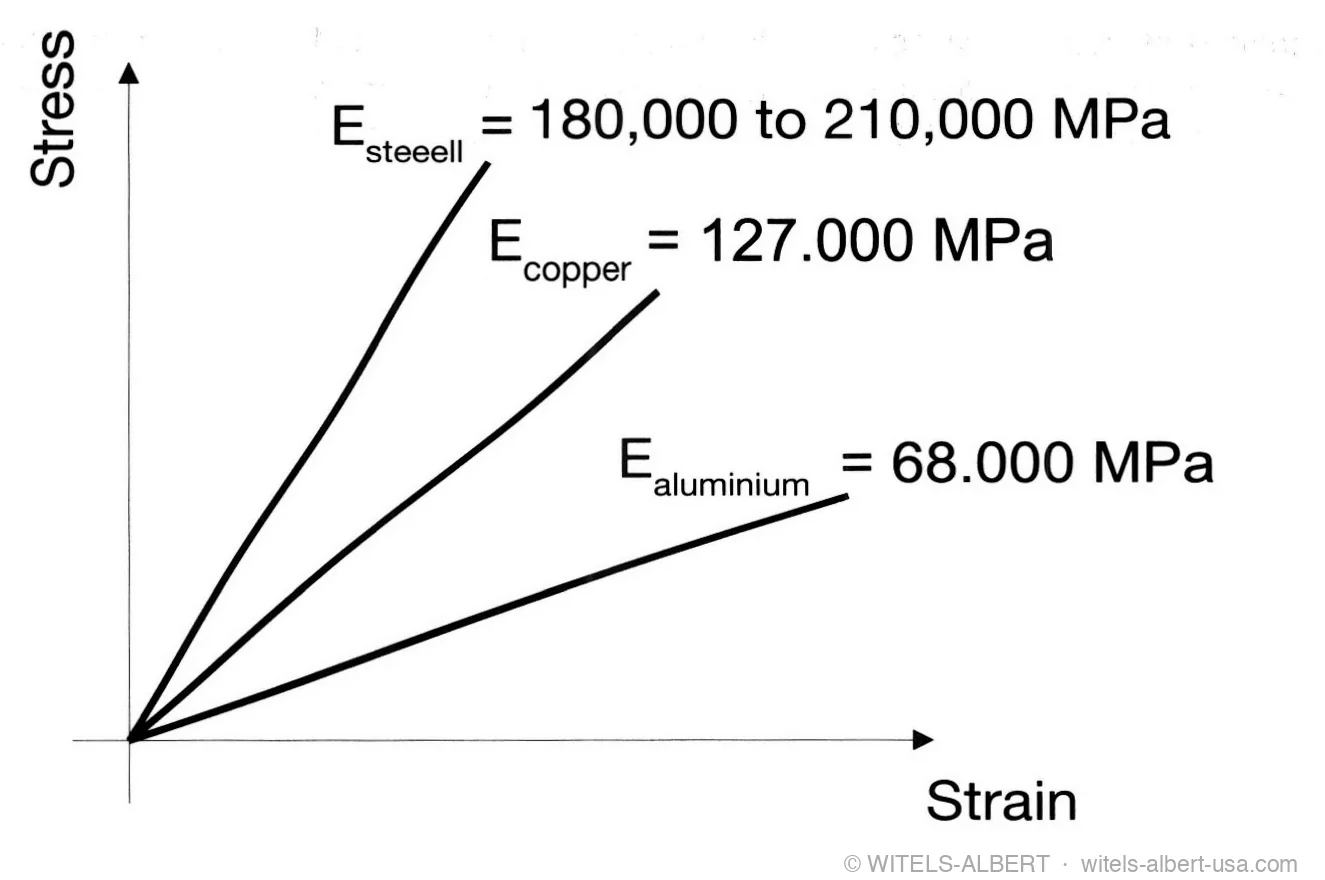
The modulus of elasticity is a characteristic material parameter determined from the data collected in a tensile test. From the beginning of the tensile up to a specific load, steel deforms elastically, i.e. its length changes proportionally to the load. This proportionality is known as Hooke's law, and in connection with the stress-strain diagram we talk about Hooke's straight line or the elastic straight line. If the load is removed after purely elastic loading of the material or tensile test-piece, the latter will readopt its original shape.
The modulus of elasticity varies in size from material to material, but it is also dependent on the material's processing condition and production process. While hot-rolled steels generally have a modulus of elasticity of 210,000 MPa, this value is never reached by drawn wire.
Drawing speeds, cross sectional reductions and other factors have a major impact on the modulus of elasticity of steel wires.
Adapted from "We do it straight" — Wire Straightening, p. 119 (ISBN 3-00-005897-4).