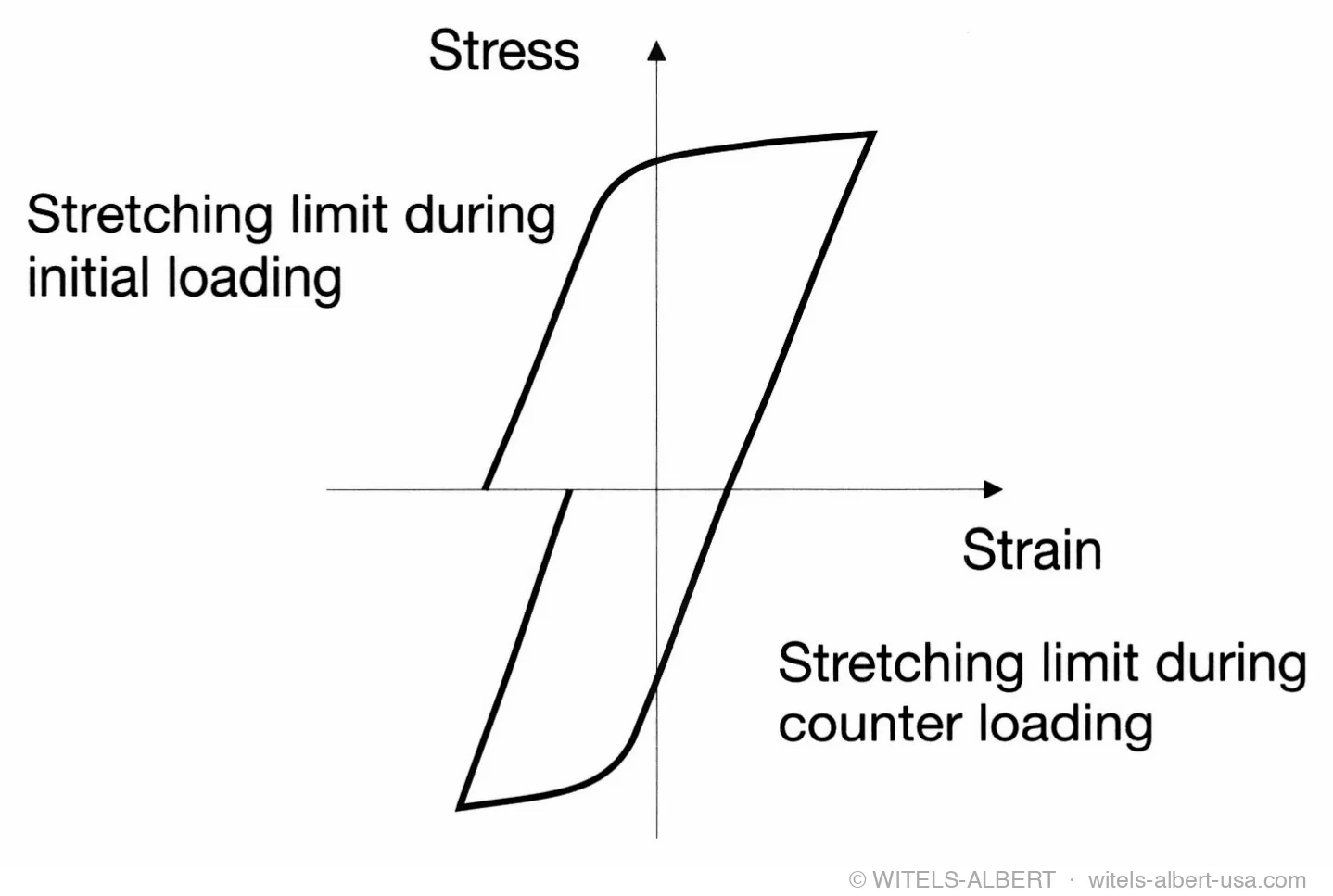
The Bauschinger effect is a special case of forming behavior among metals. It is defined as a change of material parameters due to a reversal of loading direction between two consecutive loads (e.g. tension/compression). Because of the Bauschinger effect, loading against the initial loading direction results in a distinctly lower beginning of flow (stretching limit, elongation limit). Alternating tension-compression loads result accordingly in a shift of the flow limit.
The reasons are to be found in a change of the material's microstructure. Factors affecting the magnitude of the Bauschinger effect include the material, its alloying elements (particularly carbon), the number of load cycles, and the dimensions of external deformation (actual strains).
Adapted from "We do it straight" — Wire Straightening, p. 27 (ISBN 3-00-005897-4).