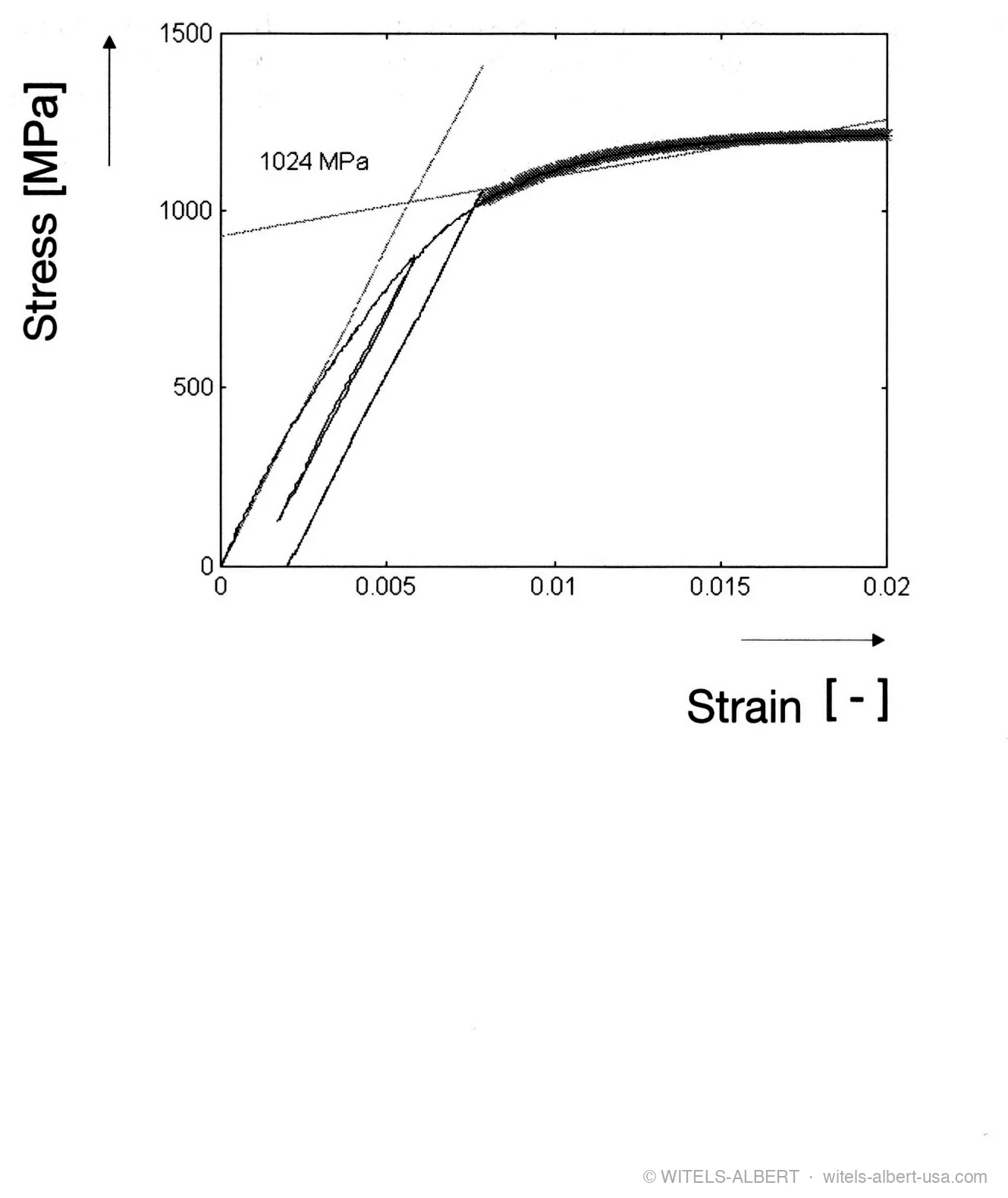
The stretching limit is a characteristic material parameter which can be determined in a tensile test. It is the stress defined as the internal force of resistance per unit of area perpendicular to the direction of load application with which a material reacts to an external tensile load of specific magnitude. At the stretching limit the deformation of the workpiece or the elongation of the tensile specimen due to the external tensile load continues to increase although the inner resistance remains constant or even decreases.
For process materials in the wire industry, where the materials used are preferably drawn wires, it is typical for the resistance to the load not to decrease at the stretching limit. Hence the stretching limit cannot be identified in the stress/strain diagram. DIN EN 10 002, the tensile test guideline for metallic materials, thus recommends determining an elongation limit at a non-proportional strain. Accordingly it is no longer the stretching limit which is determined for drawn materials in the wire industry, but the elongation limit at a non-proportional strain of 0.2%. This is also referred to as the technical elongation limit.
The stretching limit or elongation limit at a non-proportional strain is a value used in the simulation of the WITELS-ALBERT wire straightening process for calculating the adjustments required to achieve a defined final curvature.
Adapted from "We do it straight" — Wire Straightening, p. 181 (ISBN 3-00-005897-4).