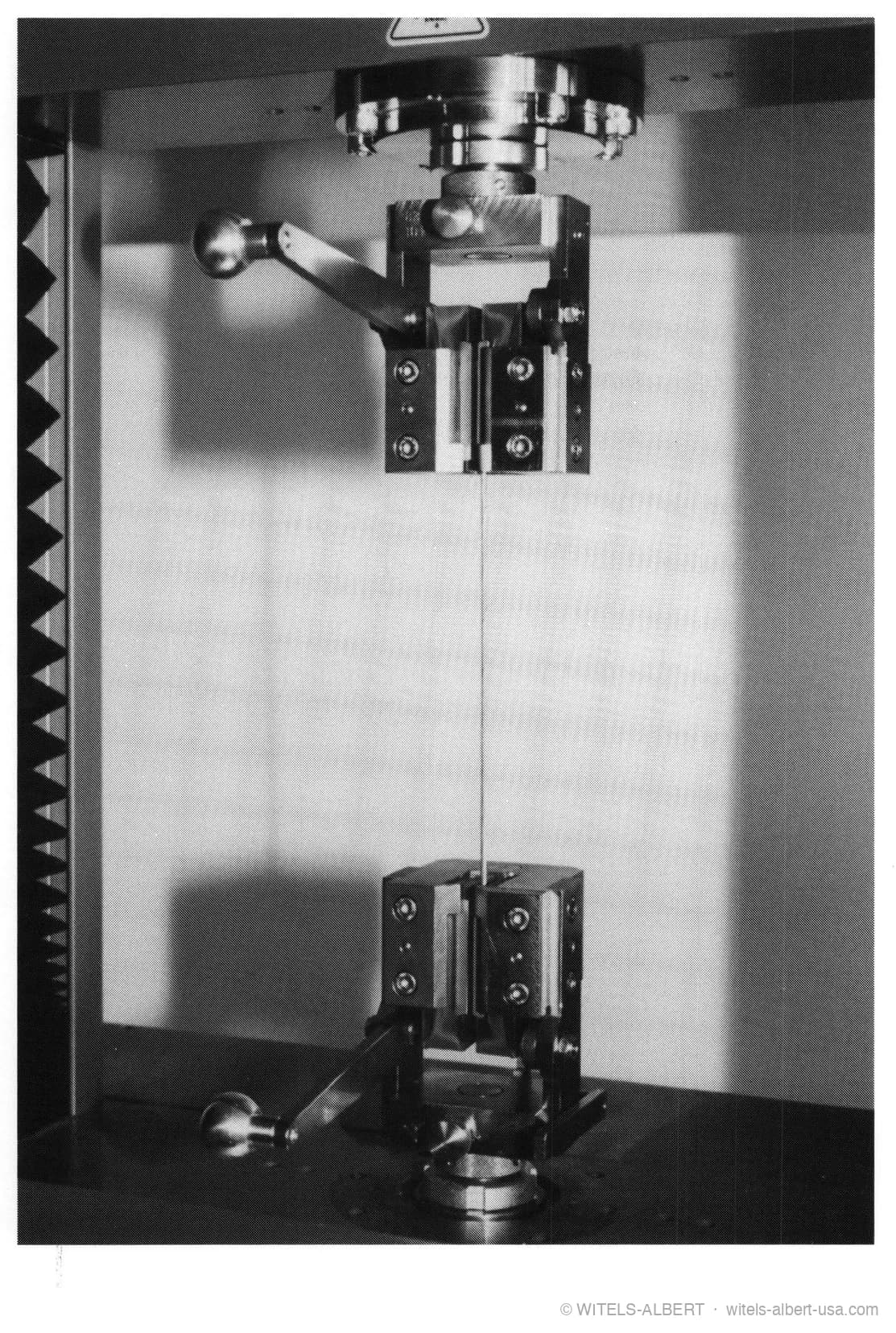
The tensile test according to DIN EN 10 002 is a static test method. It is the most important test for determining a material's mechanical parameters. A standardized test bar is subjected to an increasing tensile load in its axial direction. The test-piece, which is clamped at both ends in suitable clamping fixtures, has a specific test length which is bigger than its measured length.
The test is performed on a testing machine, often continuing until the test-piece fails. Tensile force and the change of length are recorded and plotted in a diagram. This is followed by presentation in a stress/strain diagram using the initial values for the material cross section and the test length. From the stress/strain diagram it is possible to derive parameters which express the material's behavior under external loads. The parameters most often determined are: 1. modulus of elasticity 2. stretching limit 3. tensile strength 4. elongation to fracture
Adapted from "We do it straight" — Wire Straightening, p. 189 (ISBN 3-00-005897-4).