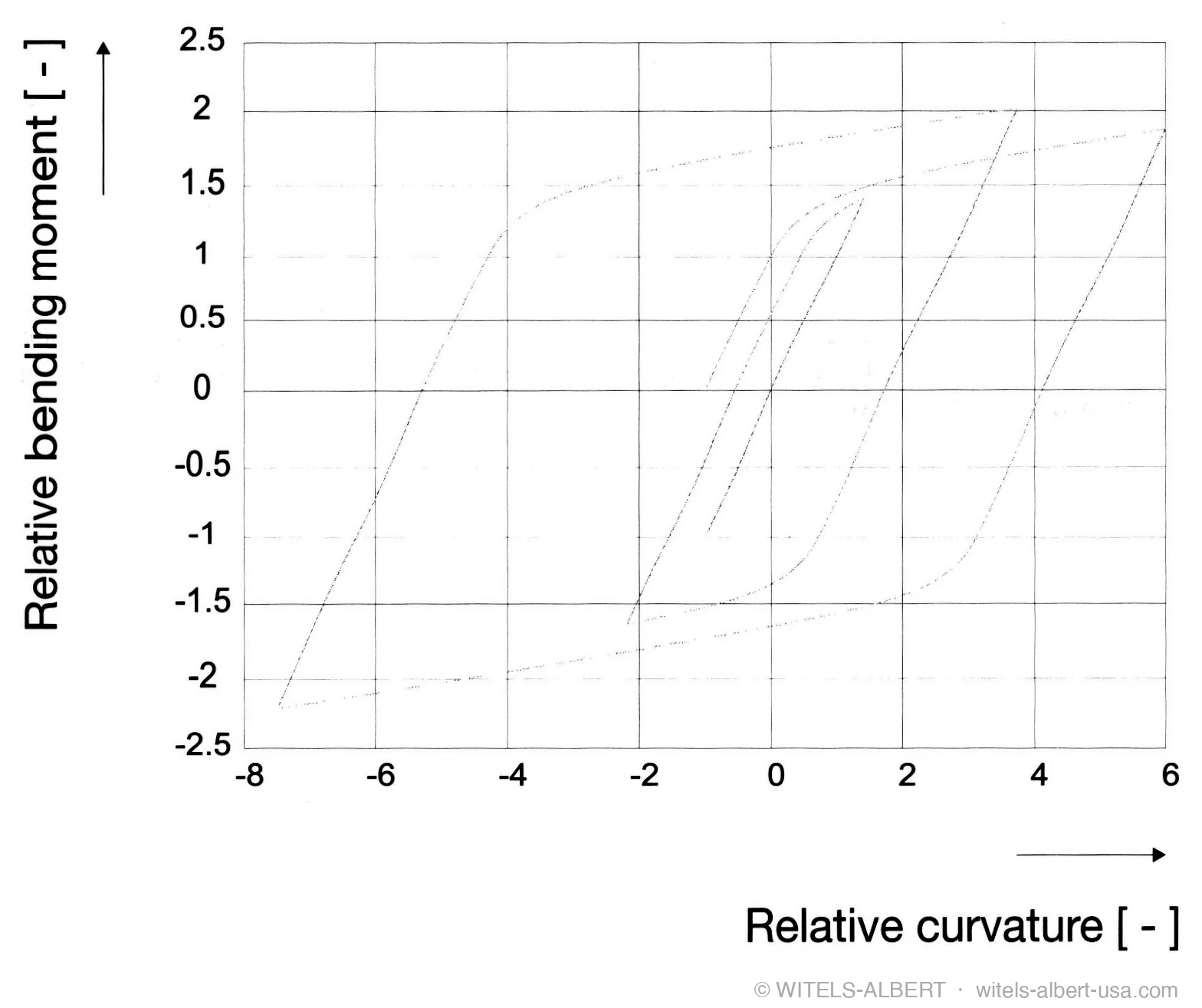
Simulation is the representation of specific interesting properties of a system by the actions of a different system. By copying the behavior of a system in a simulation program it is possible to study behavioral characteristics or to examine variants. Simulation can be used at low cost and with little risk to identify behavioral patterns in time-consuming, costly, uncertain and hazardous processes.
With a simulation of the wire straightening process it is possible to pre-calculate the positions of the straightening rolls needed to produce a defined final curvature while taking due account of the parameters of the straightener (number of rolls, external roll diameter, roll pitch, groove width, groove angle) and of the wire (cross sectional geometry, elongation limit, modulus of elasticity, modulus of hardening, initial curvature, etc.). The simulation is based on a model of the elastic-plastic material characteristic under alternate bending and on the relationship between bending moment and curvature. Simulation of the wire straightening process also supplies data which can be used to determine the process forces.
Adapted from "We do it straight" — Wire Straightening, p. 143 (ISBN 3-00-005897-4).