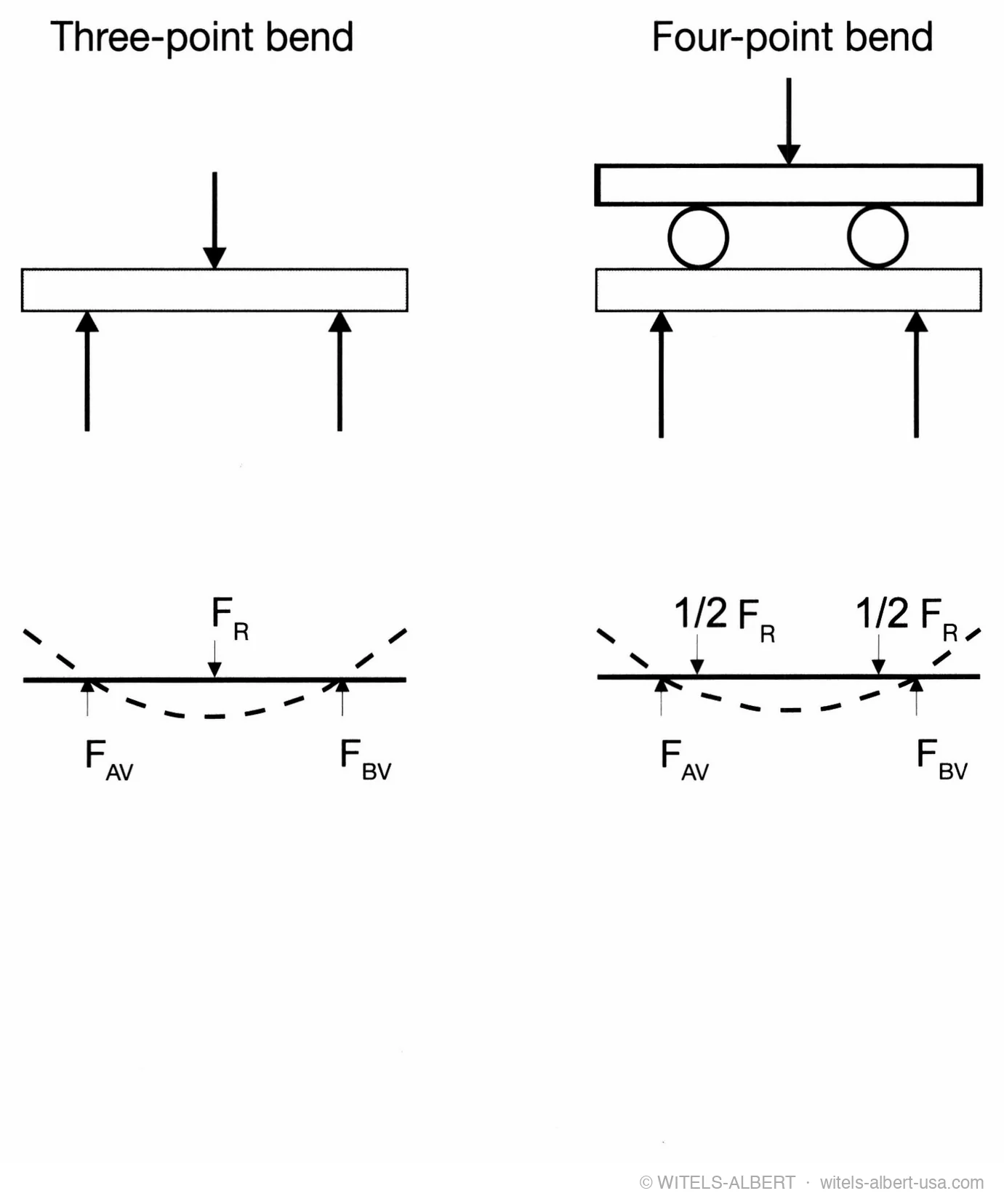
The bending test is a static testing method.
To determine the material parameters for the straightening process, bending test-pieces are investigated to measure the bends produced (similar to when rolls are adjusted during straightening) and the loads involved (forces and moments).
The result is a force-bend curve from which it is possible to derive the modulus of elasticity, the bending limit (elasticity limit) and the bending strength.
During the test the bending test-piece is subjected to both compressive and tensile stresses over its cross section.
The type of loading performed in a bending test corresponds to that which takes place during the roll-type straightening method. These values therefore represent the deformation behavior far better than those obtained by a tensile test.
It is normal to perform either three-point or four-point bending tests.
Adapted from "We do it straight" — Wire Straightening, p. 33 (ISBN 3-00-005897-4).