In production processes such as casting, rolling and drawing, the outer shape of a workpiece is preserved only if it is adjusted and clamped before the process is started so that any twisting of the workpiece is prevented. Alternatively, the workpiece has to be straightened again at the end of the process. When the external loading is discontinued and the temperature compensation completed, the workpiece adopts an intrinsic shape which continues to exist without the application of any external forces and moments. The only explanation for this condition is that the sum total of internal forces and moments, i.e. internal stresses, is in equilibrium.
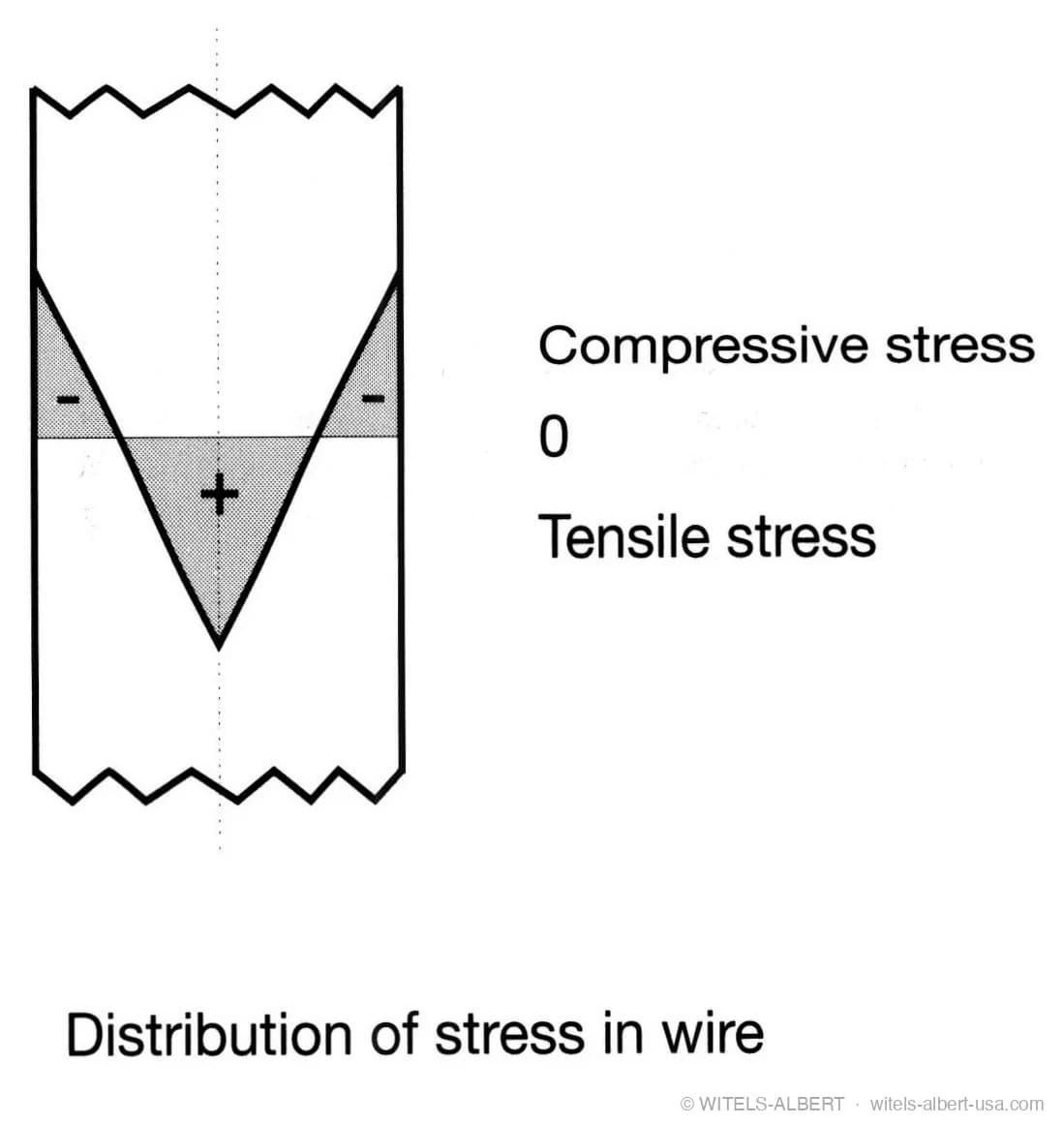
An analysis of the longitudinal internal stresses in a drawn wire reveals tensile stresses in the core and compressive stresses at the edge. Any change of a wire's parameters, such as curvature or helicity, over its length will result in changes of its internal stresses. Straightening has been shown to change the internal stresses so that the internal stress conditions existing in the material in the unstraightened state are eliminated. The magnitude and distribution of internal stresses existing after the straightening process depends on the design of the straightening system and particularly on the adjustment of the straightening rolls. With technology from WITELS-ALBERT it is possible to minimize the internal stresses arising during the straightening process while leaving the straightened material in optimal shape.
Adapted from "We do it straight" — Wire Straightening, p. 101 (ISBN 3-00-005897-4).