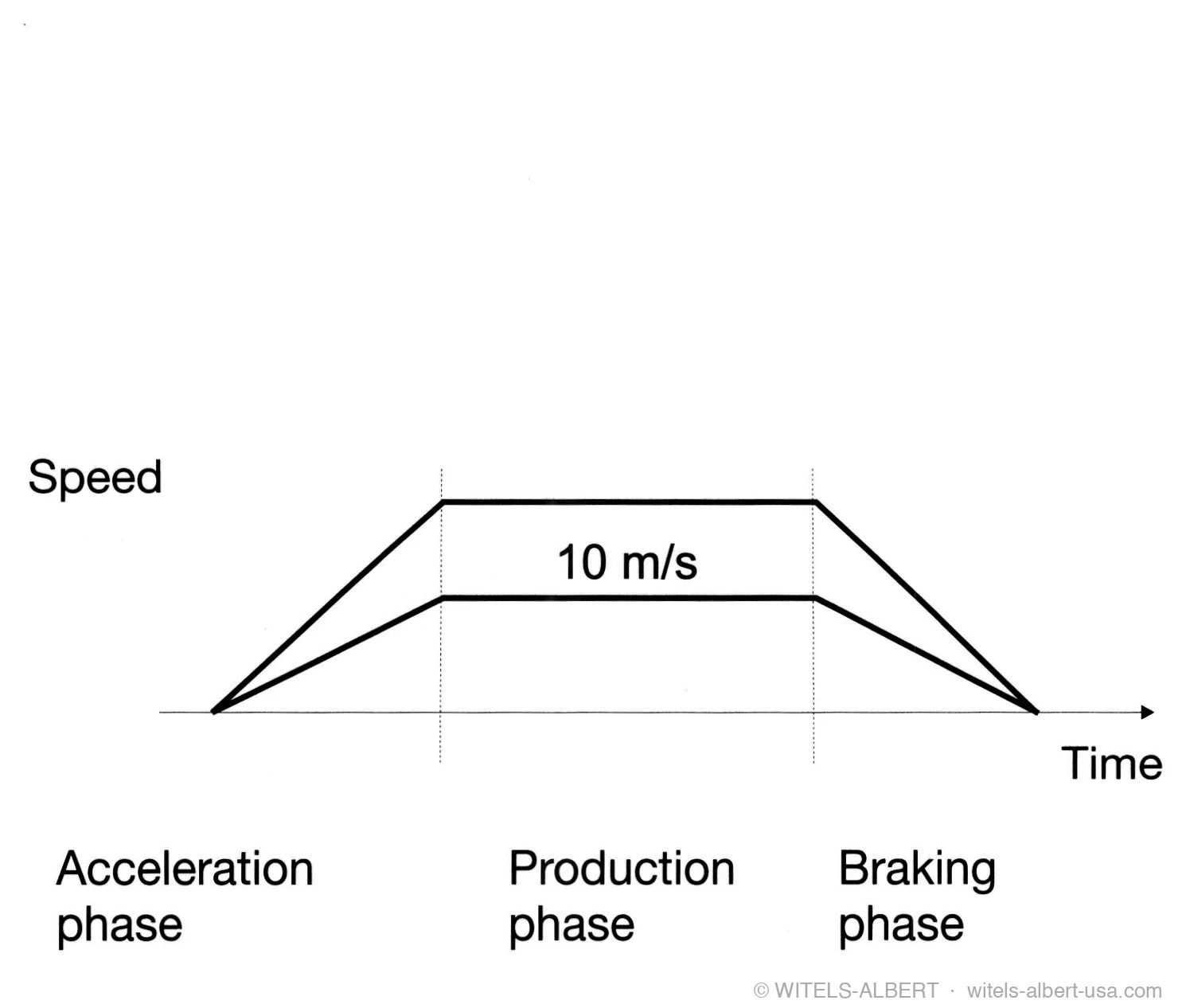
In the forming processes employed in the wire producing and wire processing industry it is normal for the process material or workpiece to move relative to the tooling. Forming speed is one of the variables which characterize a forming process. It is derived from the degree of forming as a function of time.
Exemplary straightening tests conducted at different speeds of the process have proven that the final curvature and other parameters of the straightening process do not change significantly in the speed range up to approximately 10 m/s. At speeds above this limit, an identical adjustment of the straightening rolls results in a different deformation.
Adapted from "We do it straight" — Wire Straightening, p. 145 (ISBN 3-00-005897-4).