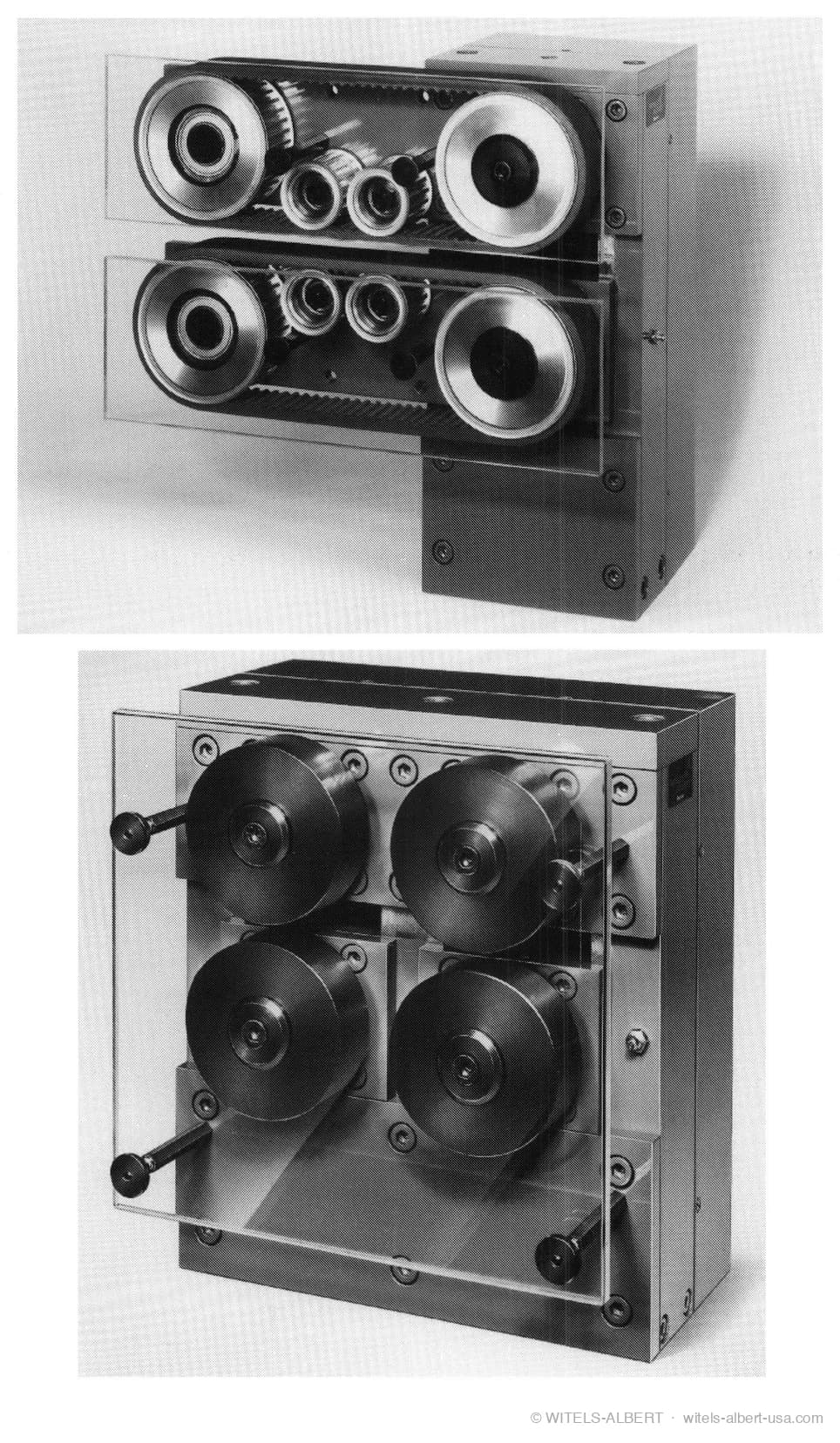
Endless material must not only be straightened, it must also be transported, pulled or pushed. Generally this is the job of the actual processing machine. Where a process is divided into various steps, drive units may be integrated upstream and downstream from the process. Dividing the process into several steps also helps to reduce process stress.
Drive units are feeding devices which clamp the material to be pulled or pushed between two or more pairs of rolls or caterpillars, using motor power to apply a tensile force. Any type of controlled or uncontrolled motor may be used according to the application. The contact force of the drive rolls or caterpillars is applied pneumatically, hydraulically, by electric motor, or manually. The level of contact force depends on the tensile force needed to move the material by frictional locking. On the one hand it must be selected high enough to move the material without slippage. On the other hand it must not be too high in order to prevent plastic deformations and surface damage.
Drive rolls are generally made of hardened steel, although other materials such as plastic, Vulkollan(r) or the like are possible. Roll profiling depends on the geometrical shapes of the materials to be transported.
Users are also free to specify any V-belt coating from the range on offer.
Four drive units have been developed for various areas of application:
- one driven pair of rolls with unilateral bearing (NA)
- one driven pair of rolls with bilateral bearing (NAB)
- two driven pairs of rolls with unilateral bearing (NAD)
- two drive belts with unilateral bearing (NAK)
Drive units are easily combined with other components, e.g. straighteners, roll-type guides, hydraulic units and pneumatic units. The resulting machine modules support existing production lines.
Adapted from "We do it straight" — Wire Straightening, p. 79 (ISBN 3-00-005897-4).