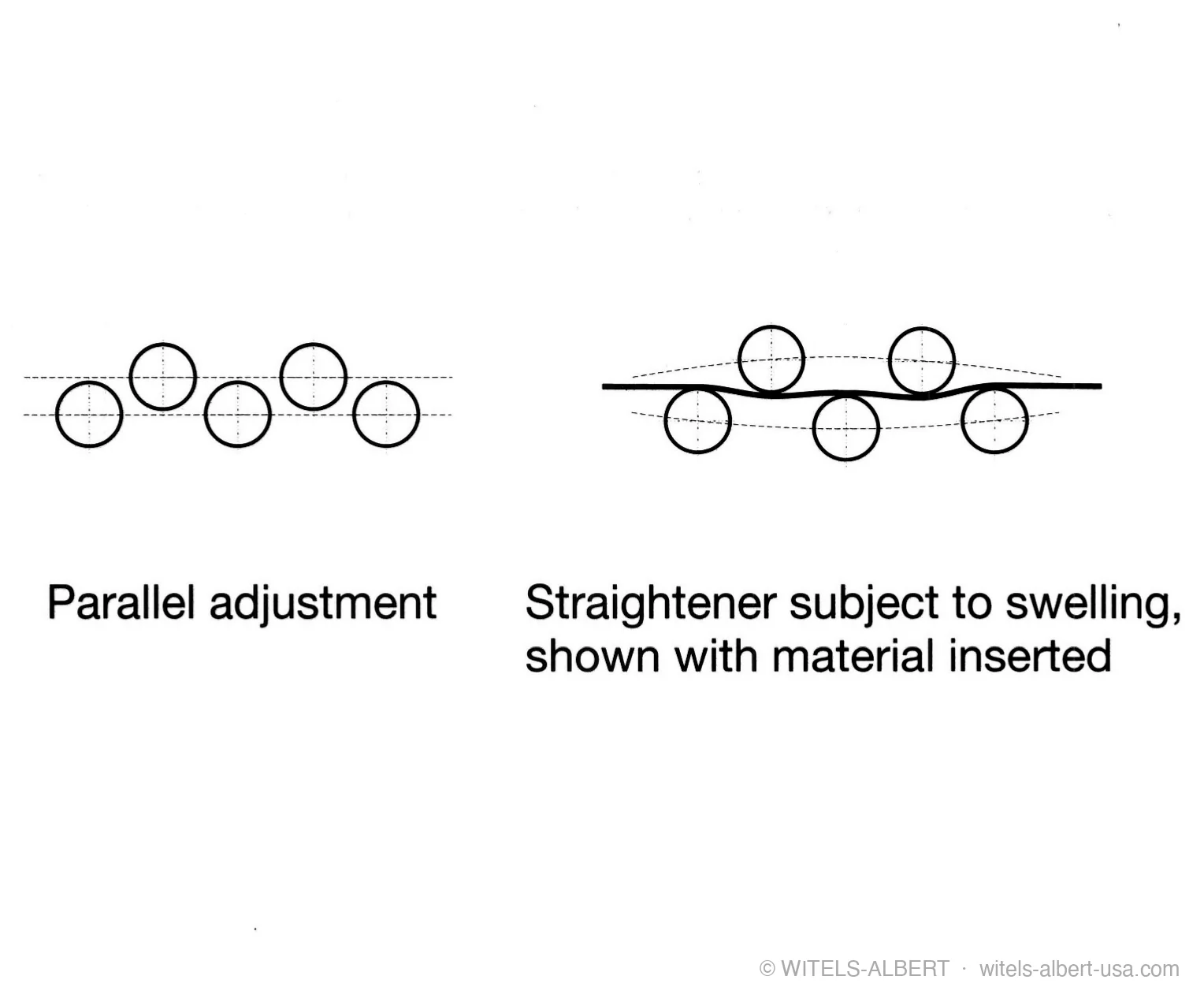
The loading of a body by mechanical variables (forces, moments) produces stresses in the body, causing the body to deform in accordance with its material characteristics. The magnitude of the load decides whether this deformation takes place in the elastic or plastic zone.
Swelling is understood to be an elastic deformation which is reverted when the external load is removed. It consists of strains, compressions and bends. Every straightener and every straightening machine swells under the action of the straightening forces. It is a characteristic of straighteners, therefore, that the adjustment of their straightening rolls becomes smaller and the straightening gap larger, leading to changing results.
Each straightener has its own force/swelling characteristic, meaning its own specific deformation behavior. This characteristic has to be determined for the straightener in question if constant straightening results are to be achieved regardless of swelling.
Adapted from "We do it straight" — Wire Straightening, p. 185 (ISBN 3-00-005897-4).