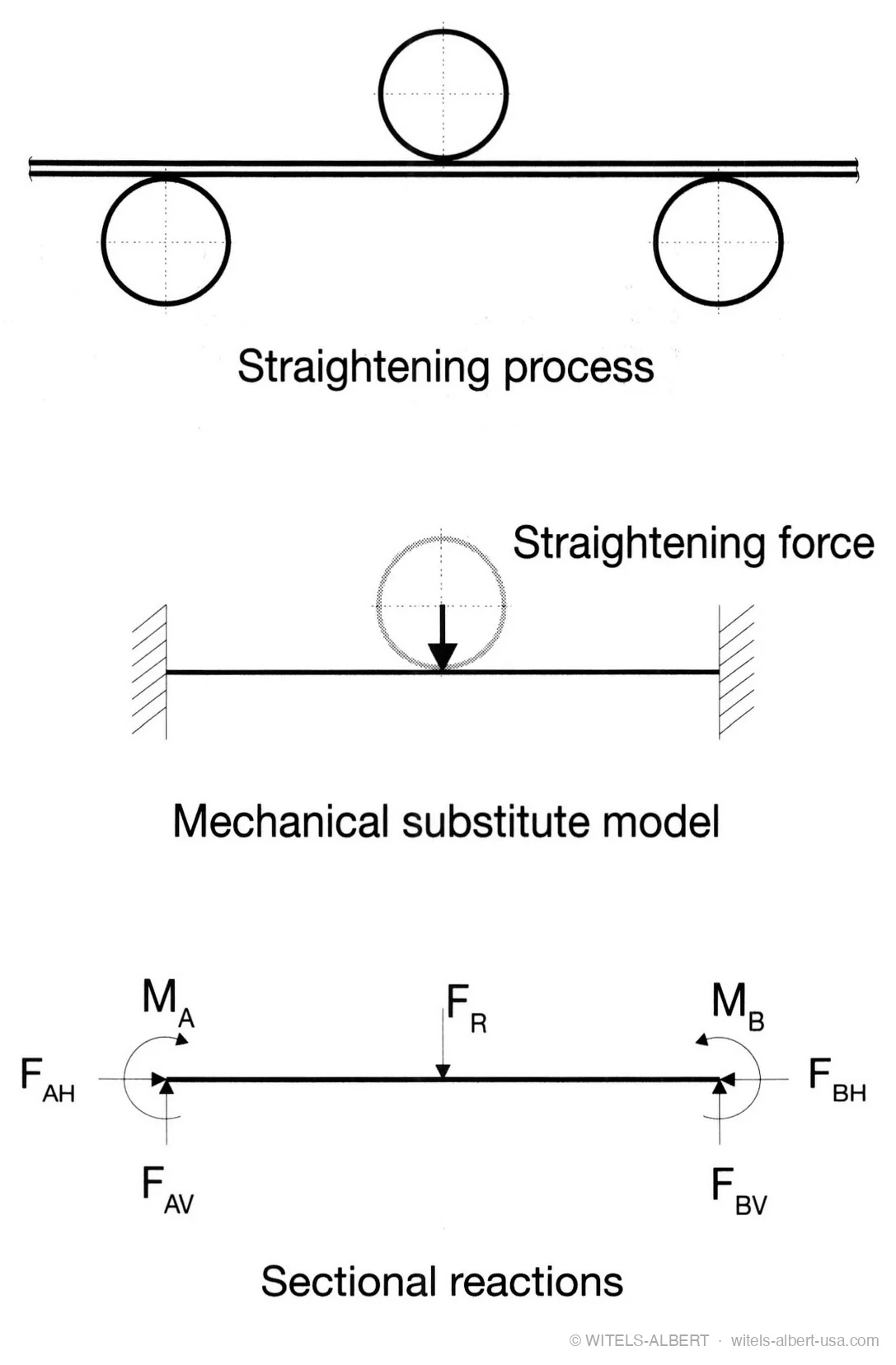
For considerations and calculations concerning the product to be straightened it is an advantage to set up a mechanical model (a level substitute model) of the real straightening process. It is then possible to make (simplified) calculations and predictions.
The definition of straightening refers to three straightening rolls as a straightening triangle. The product to be straightened can be idealized as an end-fixed beam. In addition to the forces applied, bending moments (clamping moments M) are transmitted via both supports. As these forces and moments are not equal to zero, the result is a three-component statically indeterminate system. Mechanical variables are a central force (corresponding to the straightening force), two vertical supporting forces (Fv), two horizontal longitudinal forces (Fh) and two clamping moments. The product to be straightened bends as the result of the applied straightening force (Fr).
Adapted from "We do it straight" — Wire Straightening, p. 117 (ISBN 3-00-005897-4).