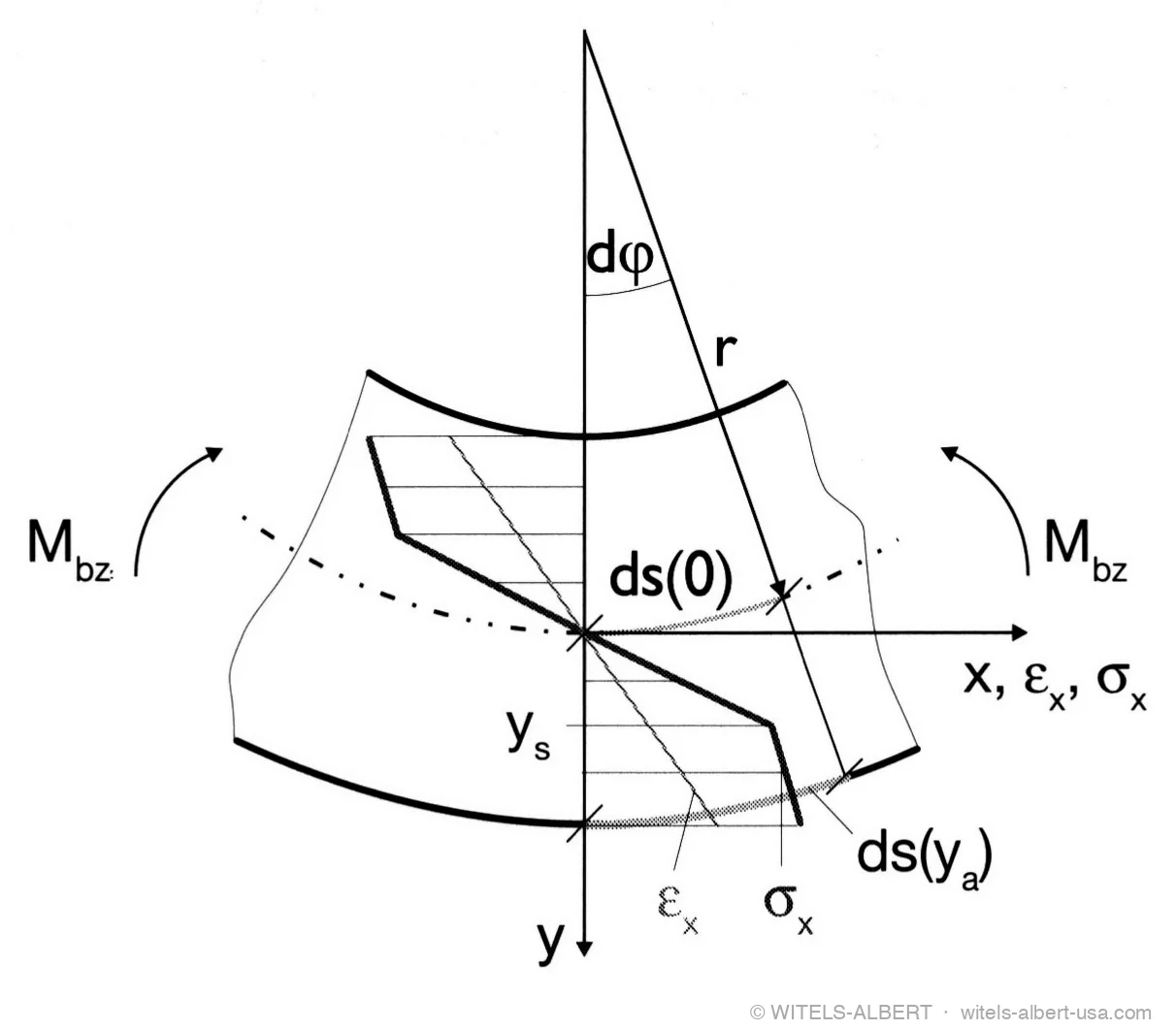
A bend is the strain produced in long and endless bodies by external forces, resulting in internal bending moments over their cross sections. The original straightness or curvature of the bodies is changed either elastically or plastically as the result. The internal bending moments arising in every cross section as a reaction to these external bending moments lead to tensile and compressive forces, resulting in an equilibrium of forces and moments.
Bodies subjected to bending are shortened on the one side by compressive stresses while on the other side they are lengthened by tensile forces. There is a (practically linear) continuous transition from tensile stress to compressive stress over the cross section, with a neutral fiber that is neither stretched nor compressed and therefore stress-free.
The diagram opposite shows a wire cross section with an applied external bending moment and the resultant strain and stress characteristic.
Adapted from "We do it straight" — Wire Straightening, p. 29 (ISBN 3-00-005897-4).