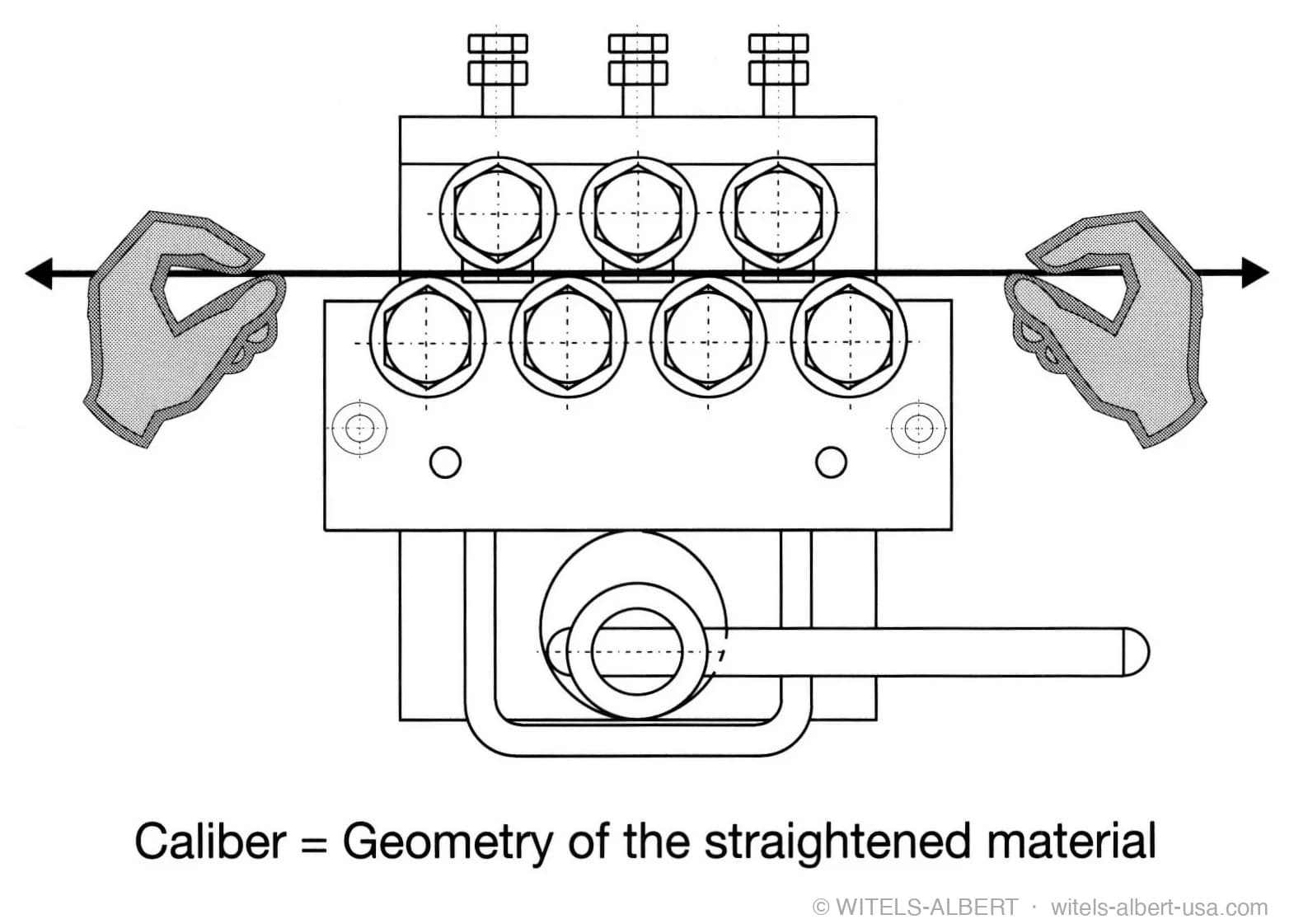
A caliber is a measuring instrument used as a gauge. In steel mills, gauges are used to determine the rolling gap. On straightening units, calibers are used to fix the distance between the straightening rolls.
When a caliber is placed between the open straightening rolls of a straightener, all the adjustable straightening rolls can be aligned on one line. The straightening rolls of the one row are thus parallel to the straightening rolls of the second row. It is then possible to set the zero line for the particular product to be straightened. The adjustable rolls are adjusted by an amount equal to the difference between the thickness of the caliber and the thickness of the product to be straightened. It should be noted that the adjusting travel is also affected by the geometry of the product to be straightened and the geometry of the groove. Adjustment positions are reproducible at any time.
Adapted from "We do it straight" — Wire Straightening, p. 37 (ISBN 3-00-005897-4).