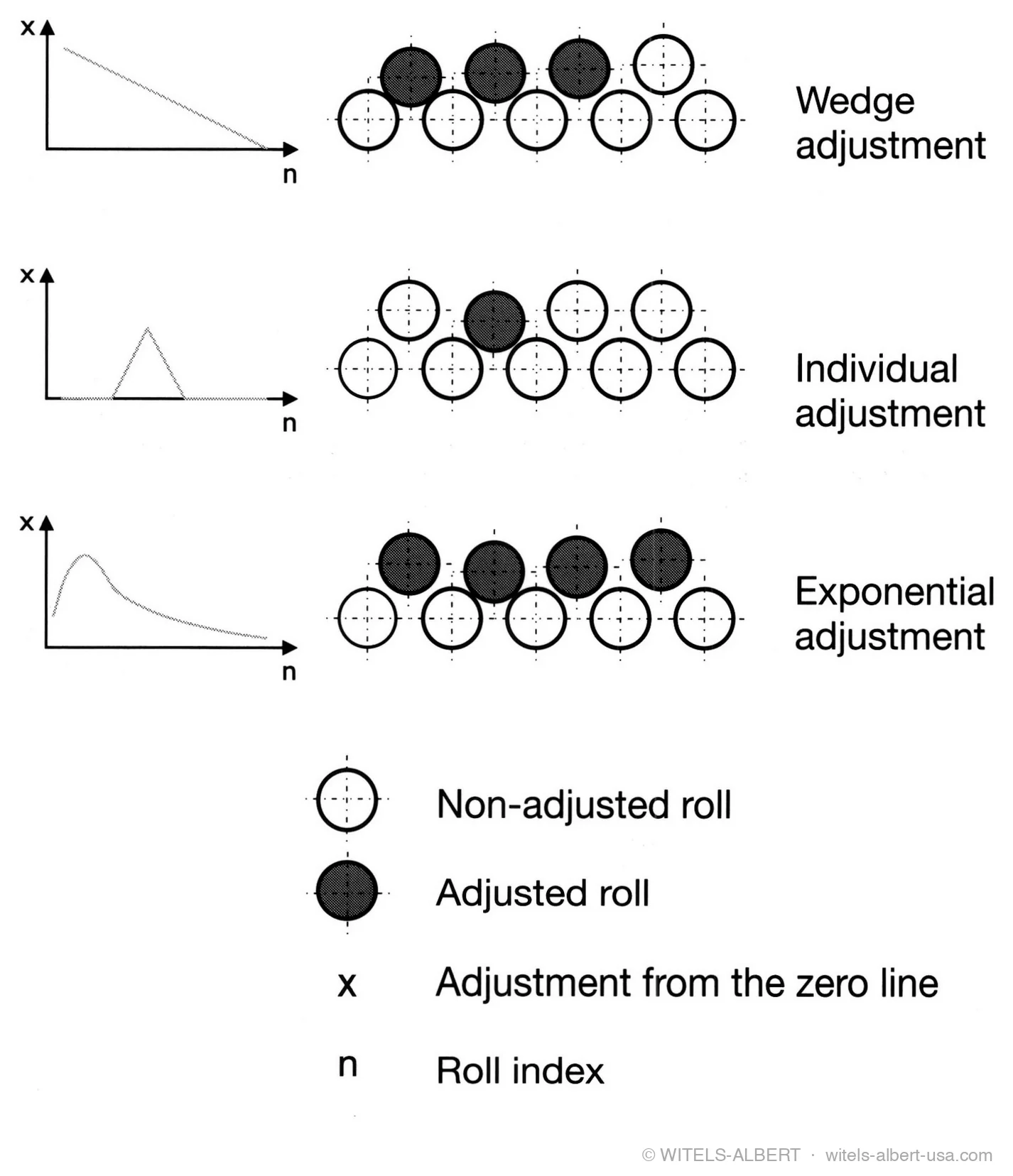
For the characteristics of a material to be changed by alternating forming on a straightener, the straightening rolls have to be adjusted relative to each other. This adjustment is understood to be the absolute position of a straightening roll relative to a specific zero line. Technologically there are various ways of making such adjustments; rail adjustment and individual adjustment are two relevant options.
With the rail adjustment method, at least one row of rolls is fastened to a rail which can be positioned by rotation and translation. By rotating the rail, the operator can obtain various pitches between the straightener's rolls according to the angle of rotation. With the individual adjustment method it is possible to position each single roll. Commonly used types of straighteners include those with one row of fixed rolls while the other rows can be individually adjusted, and those on which all the rolls can be separately positioned.
The highest degree of roll adjustment freedom exists when all the rolls of a straightener can be individually adjusted. In this case it is possible, for example, to change the initial curvature exponentially to the final curvature.
For the effective changing of initial curvatures in the initial curve zone it is recommended to select large adjustments in the front — pre-bending — section of the straightener. This results in a maximal curvature which is then reduced to the required final curvature by alternating forming in the follow-up straightening section using smaller adjustments.
Adapted from "We do it straight" — Wire Straightening, p. 15 (ISBN 3-00-005897-4).