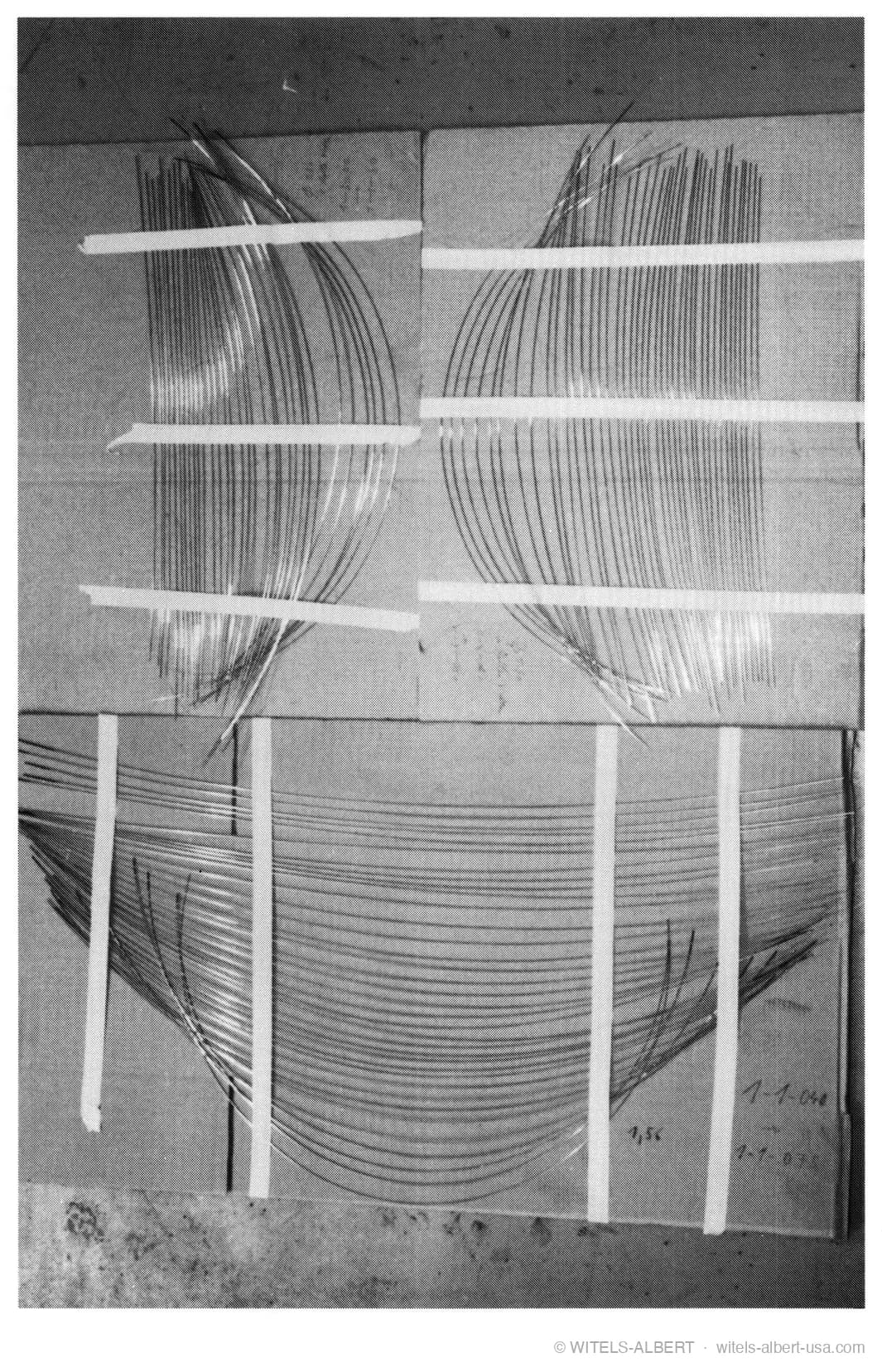
The initial curvature is the curvature displayed by the product to be straightened before it enters the straightener.
A product to be straightened does not have a single initial curvature but several, which together form the initial curvature range. The difference between the minimal initial curvature and the maximal initial curvature is the curvature range.
How do the different initial curvatures arise?
Different initial curvatures are formed, for example, during the spooling process. The inner layers of a material wound on a spool have a bigger curvature than the outer layers. Whether the material undergoes elastic or plastic bending depends on many factors such as the material, geometry and dimensions of the product, the inner and outer diameter of the spool, and the temperature during winding.
Different initial curvatures of the product to be straightened also arise from its incorrect processing or deflecting. Helicities result in addition from changes to the directions of curvature in various curvature planes.
Adapted from "We do it straight" — Wire Straightening, p. 99 (ISBN 3-00-005897-4).