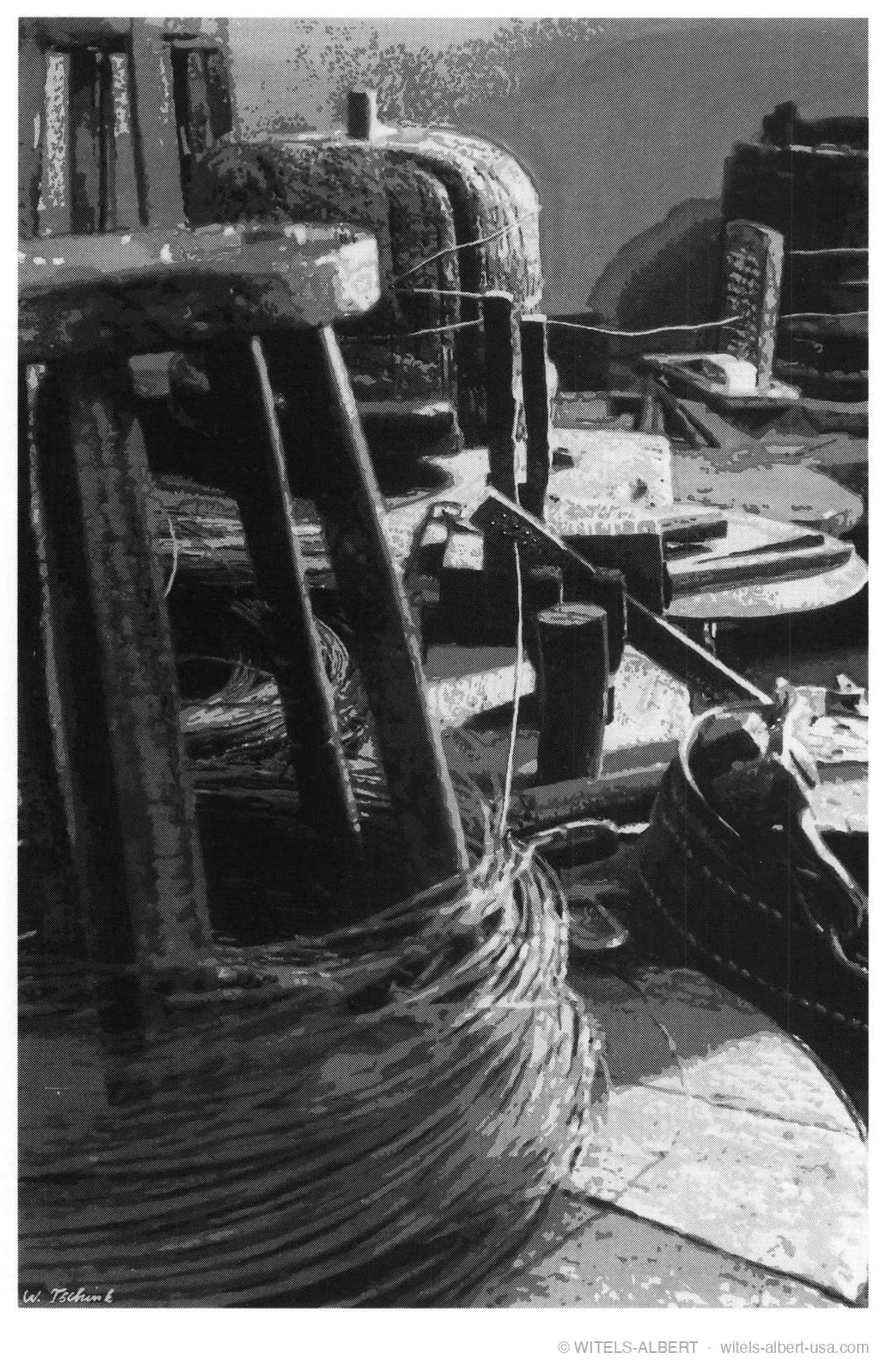
The fine wire drawing set-up with wooden drawing die pictured on the opposite page was still in use at a number of wire drawing mills at the end of the 19th century. These dies were made from birch wood taken from handpicked, healthy trunks of sufficient thickness. First the trunks were sawn to length, debarked, rough-turned and drilled. Then they were covered with a coating of brown soap and cooked in large water boilers. As reinforcement, wedges of sheet iron approximately 2 mm thick and set about 8-10 mm apart were knocked into the wood in line with the edge of the block.
These metal wedges were approximately 50 to 60 mm long and around 15 to 20 mm wide. To protect the die when knocking in these wedges, the lower edge of the hole was first covered with an iron hoop, which could be removed later.
Finally, the outer shell was finish-turned and a driver bridge with a square hole set in the bottom.
These dies were mainly used to draw thin brass and copper wires, and later also for iron and steel.
Adapted from "We do it straight" — Wire Straightening, p. 87 (ISBN 3-00-005897-4).